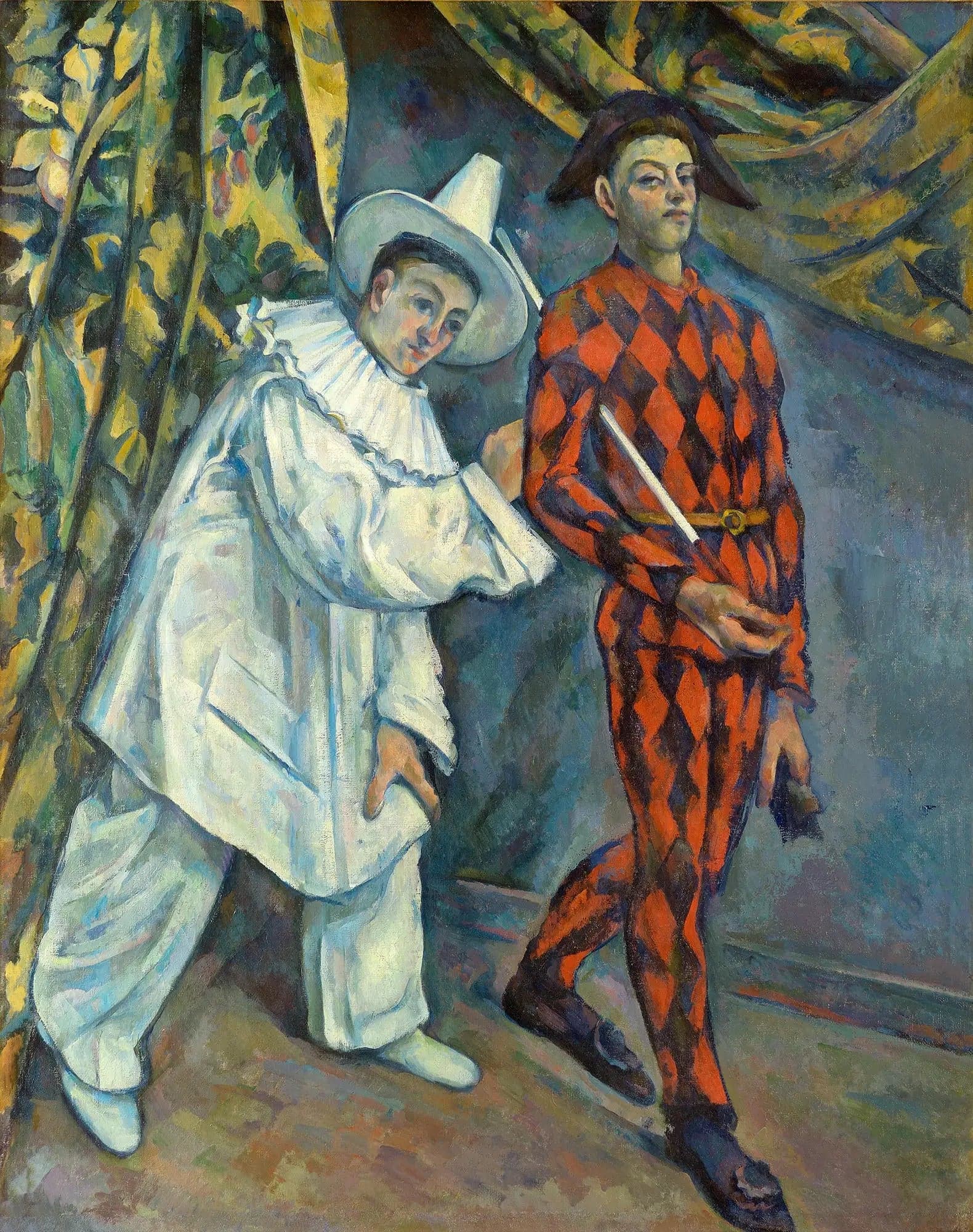
Mardi Gras
- Original dimensions
- 81 x 102 cm
- Museum
- Pushkin Museum of Fine Arts
- Year
- 1888
Scene depicted
The painting "Mardi gras" depicts a vibrant scene, where participants mingle in a whirlwind of colors and emotions. Each character, caught in their own moment of celebration, reveals the richness of social life at the time. Cézanne, through this composition, captures the essence of a celebration, both joyful and thrilling, rooted in an eternal movement.
Historical context
Created in 1888, the painting "Mardi gras" is rooted in the vibrant context of the late 19th century in Paris, a time when post-impressionism was emerging. Radiating a festive atmosphere, this canvas reflects the energy of a bustling Paris. Currently, this canvas , emblematic of its creator, resides at the Pushkin Museum of Fine Arts , where it shines with its unique interpretation at the heart of a prestigious collection.
Place in the artist's career
This painting marks a turning point in Cézanne's career, signaling a period of artistic maturation. It beautifully positions itself between his precursor works like "The Apples and the Oranges" and "Mont Sainte-Victoire," illustrating an evolution towards more abstract forms and bold color palettes.
Anecdote
Paul Cézanne , immersed in the excitement of a Mardi gras in Aix-en-Provence, reportedly said: "Every color is a note, and I compose my melody in oil and linen." Contemplating this masterpiece , one feels these whispers of life, airy, uniting with each brushstroke on the canvas .