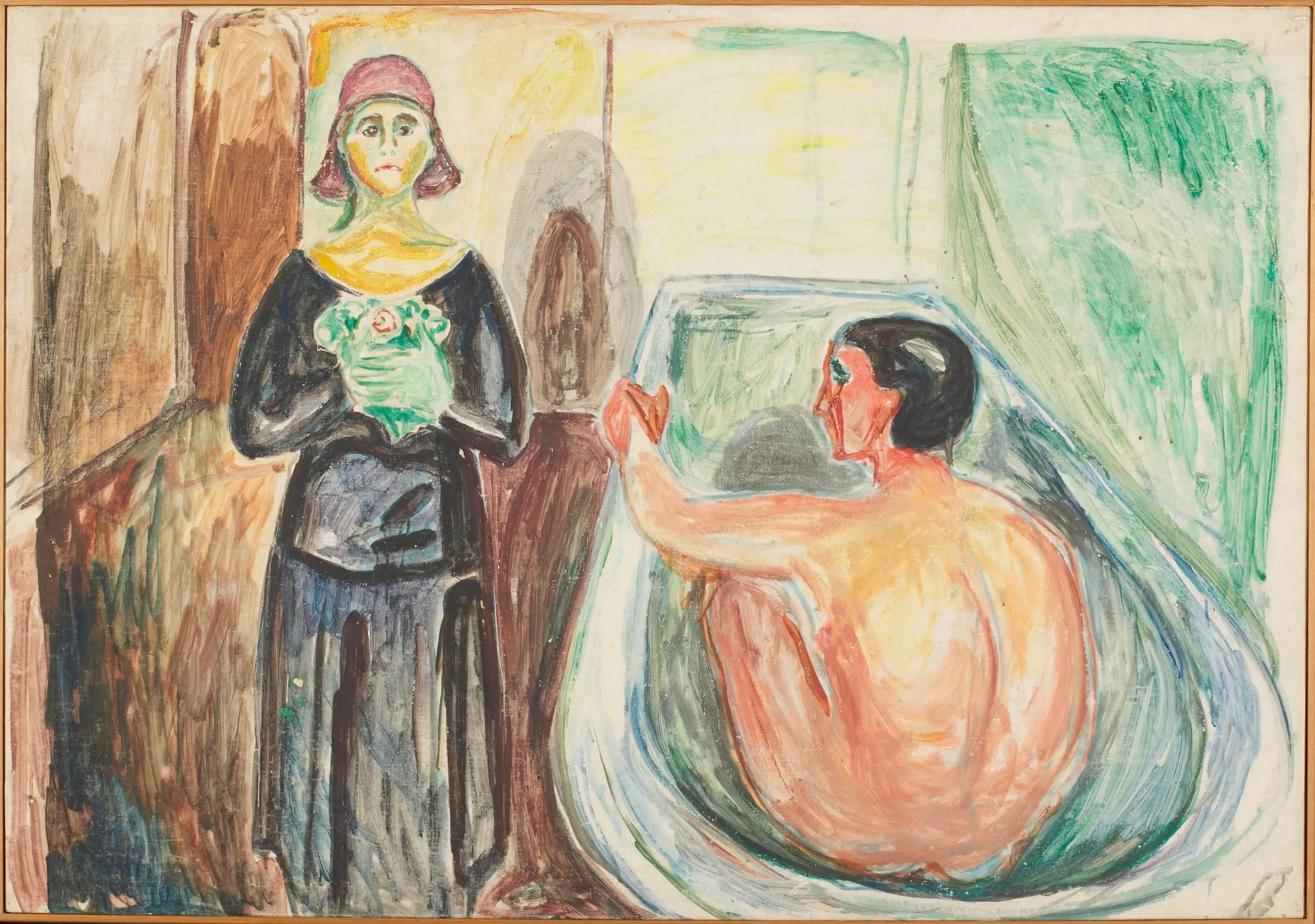
Marat in the Bath and Charlotte Corday
- Original dimensions
- 119 x 83 cm
- Museum
- Munch Museum
- Year
- 1930
Scene depicted
This canvas – a visual testimony of a historical drama – stages the tragic moment when Charlotte Corday assassinates Jean-Paul Marat, the famous revolutionary. Immersed in his bathtub, lost in the reading of his thoughts, he is unaware that his life is about to turn in the fateful moment. This composition embodies both human vulnerability and the political turmoil of the revolutionary period, linking the past to a surge of timeless emotion.
Historical context
This painting emblematic, created in 1930, is set in the vibrant artistic framework of Oslo, Norway. It is part of the expressionist movement, characterized by a quest for intense emotions and a subjective representation of reality. Today, this canvas captivating resides at the Munch Museum, a sanctuary dedicated to the artist's work, where its evocative power continues to fascinate visitors with its dimensions of 119 x 83 cm.
Place in the artist's career
Marat au bain et Charlotte Corday marks a crucial step in Munch's career, illustrating his transition to a more intense and dramatic style. After landmark works like The Scream and The Madonna , this painting highlights an emotional turning point, where the artist merges the historical event with a strong visual impact, reflecting impressive artistic maturity.
Anecdote
“Art must not only be seen, it must be felt.” These words resonate as a source of inspiration for Marat au bain et Charlotte Corday , conceived during a winter evening, where Munch observed diffuse shadows and poignant silhouettes. It is in this atmosphere imbued with melancholy that this masterpiece was born, a call rooted in history, to the interaction between the beautiful and the tragic.