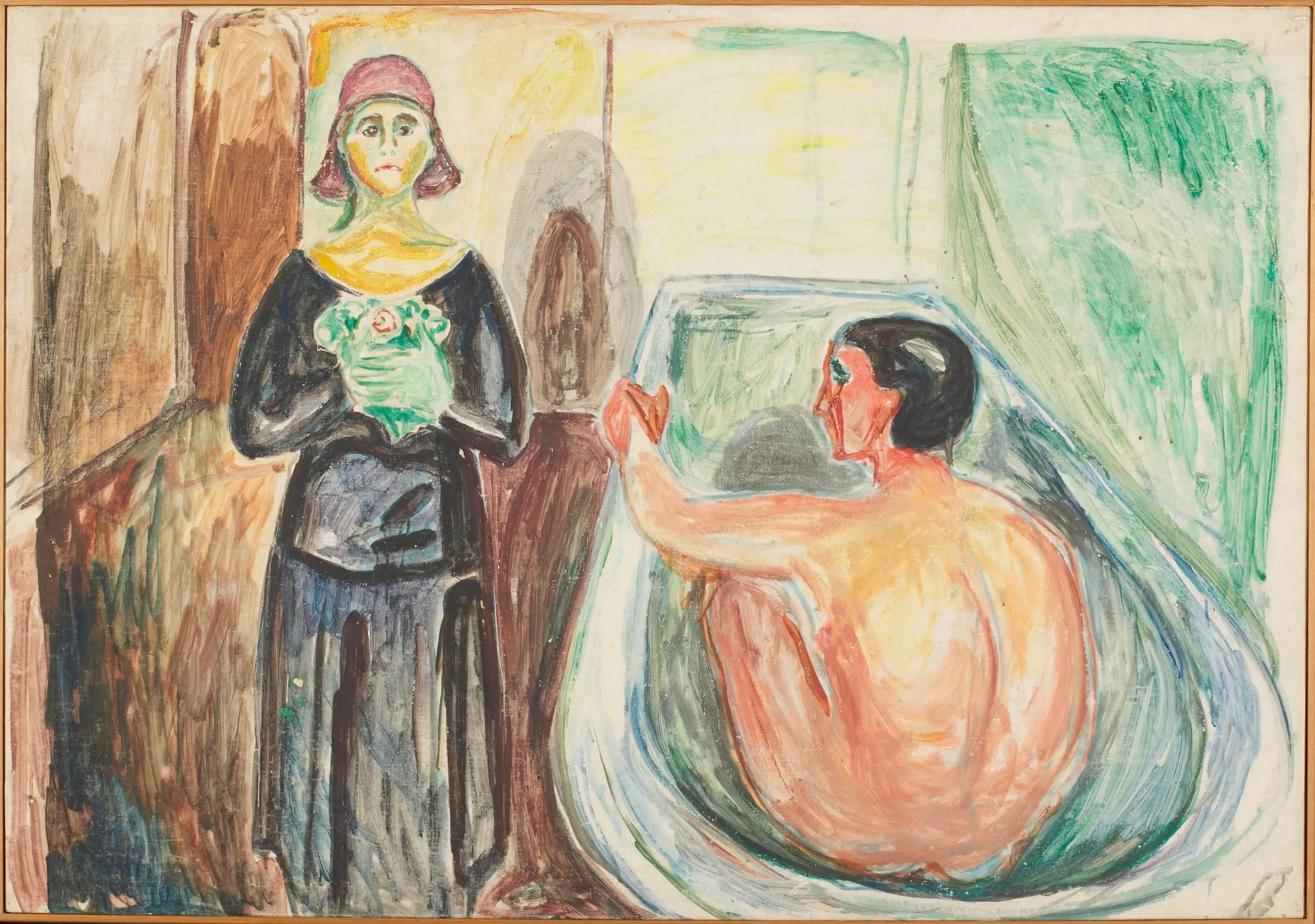
Marat in the Bath and Charlotte Corday
- Original dimensions
- 120.5 x 80.5 cm
- Museum
- Munch Museum
- Year
- 1930
Scene depicted
This painting depicts the famous scene of the death of Jean-Paul Marat, stabbed by Charlotte Corday, a key figure of the French Revolution. By blending the real and the symbolic, Munch dramatizes the ultimate confrontation between ideal and despair, each gesture and gaze on the canvas tells a story of heightened human passions.
Historical context
Created in 1930, this painting is set in a rich and troubled context, typical of the interwar years in Europe. Edvard Munch , master of symbolism and expressionism , created this iconic painting at the Munch Museum, located in Oslo, Norway. This painting recounts a dramatic moment in history, while the dimensions of 120.5 x 80.5 cm capture the emotional intensity of this pictorial work .
Place in the artist's career
The painting “Marat au bain et Charlotte Corday” marks a turning point in Munch's career, oscillating between his promising beginnings and the stylistic peaks he would later reach. Alongside other paintings like “The Scream” and “The Madonna,” this work illustrates the evolution of his emotional approach, a balance between melancholy and pain.
Anecdote
“I paint dreams, and art is my breath,” said Munch, one sunny morning in his studio filled with vibrant colors. It is in this intimate space that he found inspiration for this masterpiece , a symbolic interpretation of the tragic conflict between Marat and Corday, dictated by palpable tension.