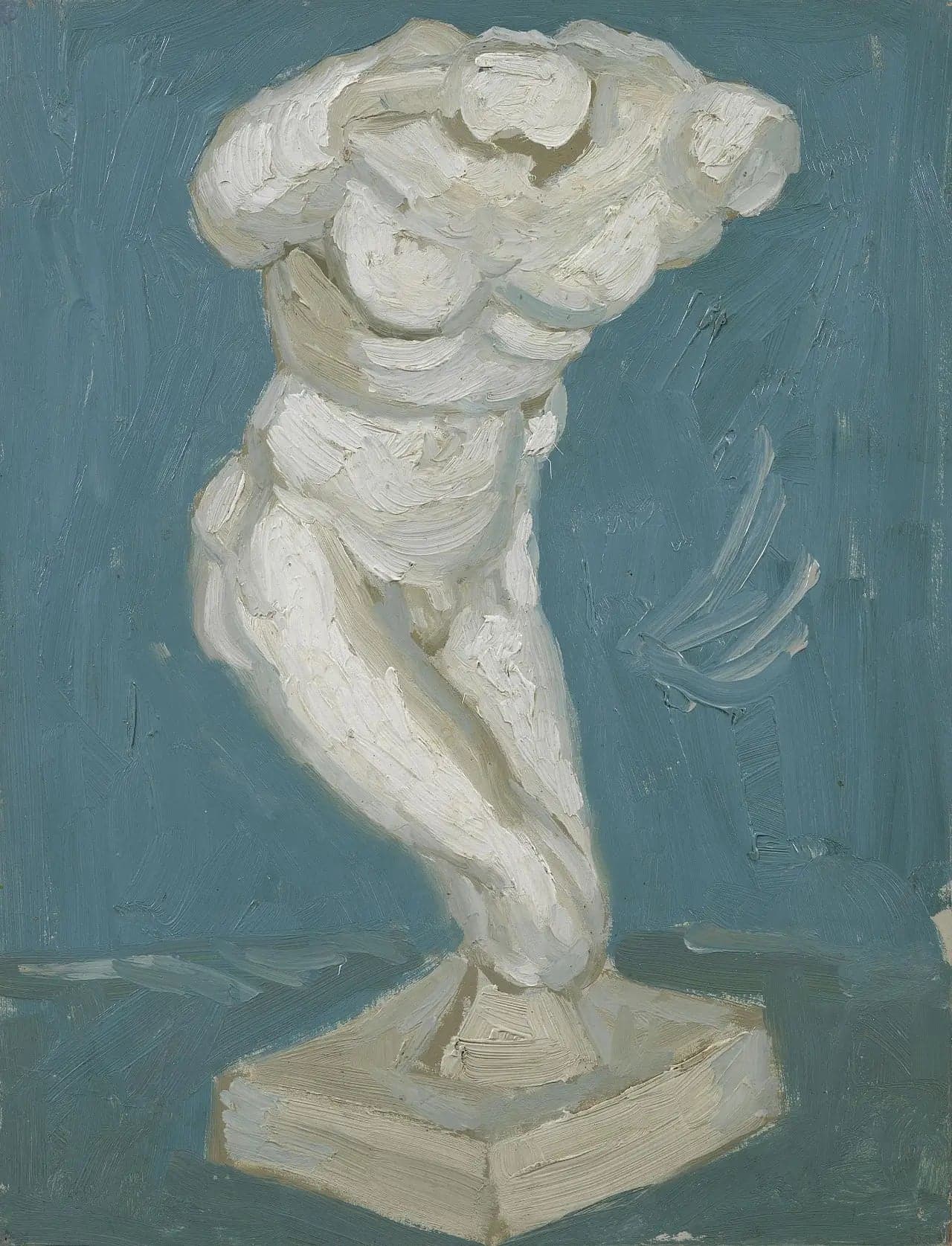
Man's Torso
- Original dimensions
- 27 x 35 cm
- Museum
- Van Gogh Museum
- Year
- 1886
Scene depicted
The painting “Torse d'homme” immerses us in the intimacy of a suspended moment. The viewer's gaze is drawn to the raw strength and fragility of a naked body, paying homage to its enchanting form, but also to human vulnerability. Van Gogh, with great meticulousness, immortalizes this torso, inviting each of us to reflect on our own existence.
Historical context
Created in 1886, in Paris , this painting , emblematic of the post-impressionist movement, offers a fascinating glimpse into the artistic exploration of the Dutch master. At that time, Vincent van Gogh experimented with human bodies, seeking to capture the very essence of the human condition. Currently, the painting is displayed at the Van Gogh Museum , where it continues to amaze visitors with its expressive power.
Place in the artist's career
“Torse d'homme” is situated at a pivotal moment in Van Gogh's career. After his training period, he enters a phase where his artistic expression reaches unparalleled maturity. Compared to masterpieces such as “ The Sunflowers ” and “ The Starry Night ”, this composition reveals a significant evolution in the use of colors and forms.
Anecdote
“I seek to express the emotion that lies behind every form,” said Vincent. In a Parisian alley, one spring morning, he encountered the silhouette of a man whose torso, illuminated by soft light, ignited a creative flame within him. It is this emotion, combined with his burning desire to pay tribute to life, that permeates every brushstroke of this pictorial work .