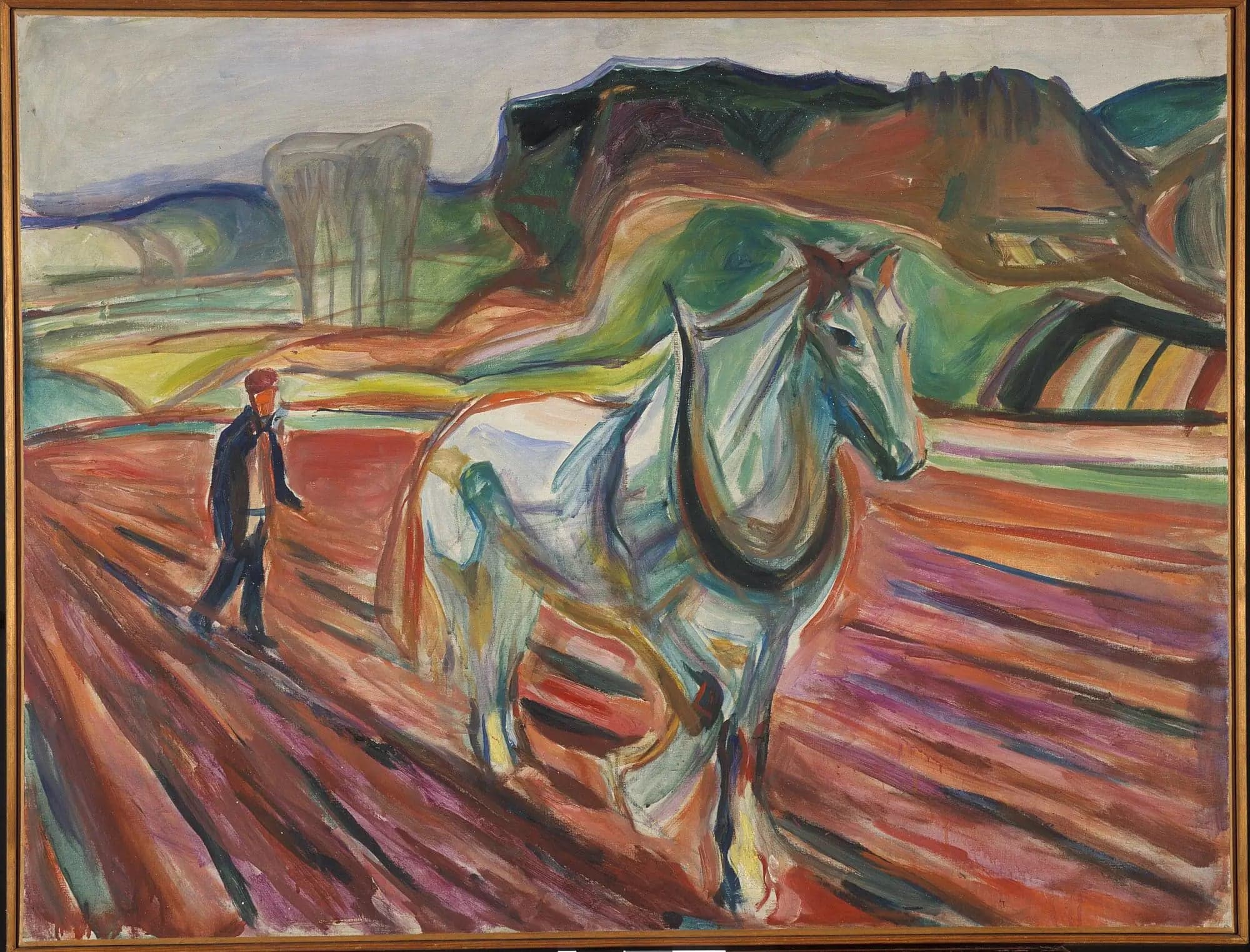
Man Working with a White Horse
- Original dimensions
- 110.5 x 90.5 cm
- Museum
- Munch Museum
- Year
- 1919
Scene depicted
In this canvas , we discover a robust man, his gaze focused, guiding a white horse through a rural landscape. This painting embodies the struggle between man and nature, a scene where every detail of the painting tells a story of labor and devotion. The soft light floods the space, creating an atmosphere imbued with tranquility and respect.
Historical context
Created in 1919, this painting is an emblematic reflection of an era marked by a quest for authenticity and heightened expressiveness. Located in Oslo, Norway, the canvas belongs to the Symbolist movement that profoundly influenced the artistic journey of Edvard Munch . Currently, this exciting work is preserved at the Munch Museum, a sanctuary of his legacy.
Place in the artist's career
Man Working with a White Horse represents a pivotal period in the artistic trajectory of Edvard Munch , illustrating both his mature style and his pronounced taste for themes of nature. Compared to his earlier works like The Night and The Dance of Life, this painting testifies to an evolution towards a more humanistic and profound approach to reality, while retaining the emotional imprint so dear to the artist.
Anecdote
“Nature and man are one” Munch might have said while contemplating the dawn over the field. Inspired by this deep connection, he captured this moment of communion between a man and his horse, a formidable symbol of human effort. This canvas evokes the simplicity of a life tied to the land, exalting the artist's emotions through every brushstroke of the painting .
Major exhibitions
Munch og Ekely: 1916-1944