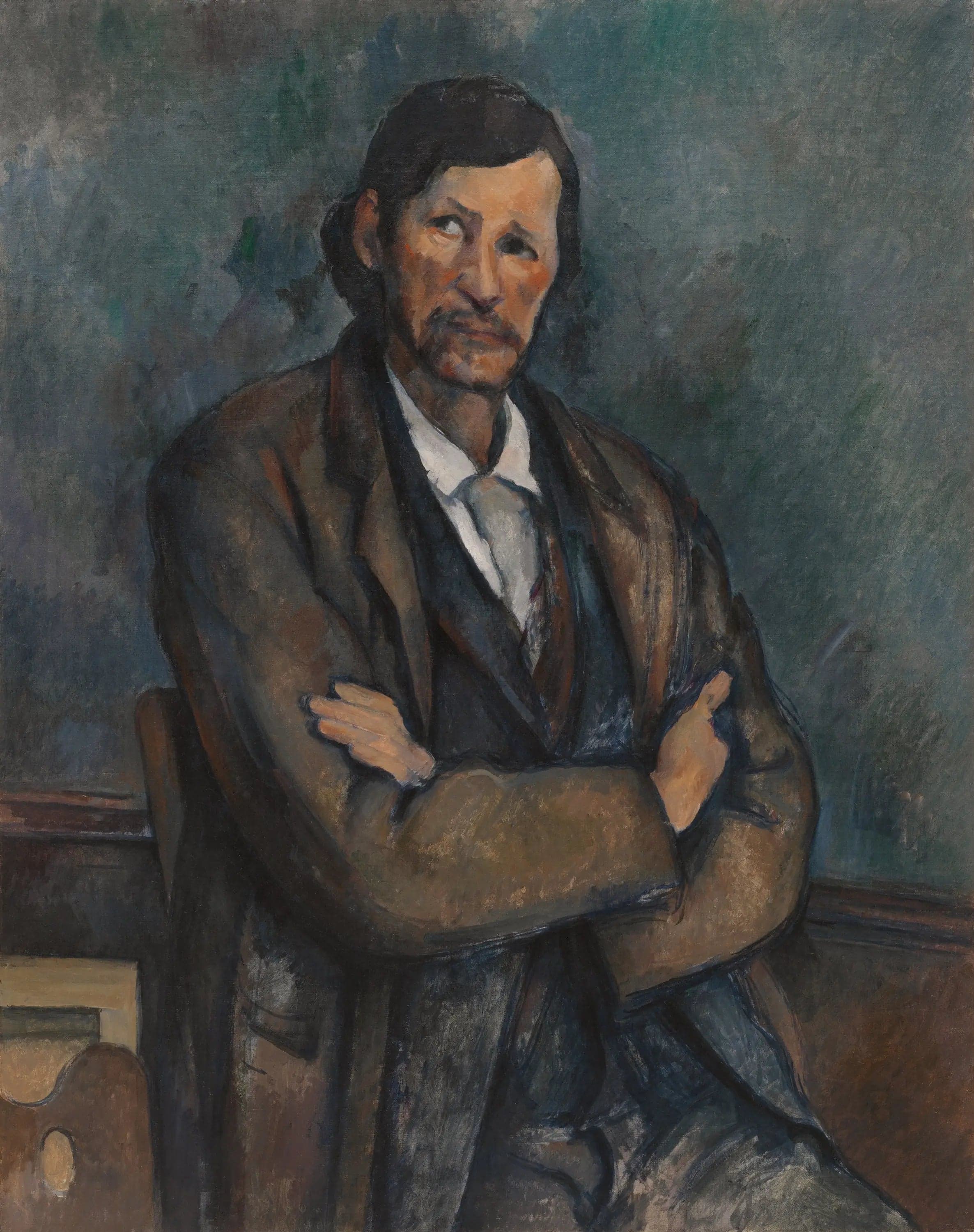
Man with Crossed Arms
- Original dimensions
- 72.7 x 92 cm
- Museum
- Solomon R. Guggenheim Museum
- Year
- 1899
Scene depicted
In this pictorial work, Cézanne depicts a man with a pensive gaze, frozen in a moment of introspection. With his arms crossed and an impassive face, he embodies reflection on his own existence. The composition of the canvas transports us beyond a simple portrait, challenging the viewer to experience the emotions buried behind this static face.
Historical context
In 1899, in Aix-en-Provence, the cradle of Impressionism , Paul Cézanne , an iconic figure of modernity, created this monumental painting . Falling within the artistic movement that combines realism with Impressionism , this canvas is imbued with a unique spirit that resonates with the transitional period towards greater abstraction. Today, this masterpiece is displayed at the Solomon R. Guggenheim Museum in New York, a place where modern art comes to life. Its dimensions of 72.7 x 92 cm make its presence a strong moment of contemplation.
Place in the artist's career
"Man with Crossed Arms" marks a crucial stage in Cézanne's career, signifying both a return to the human figure and an affirmation of his artistic maturity. This painting can be compared to other major works such as "The Montagne Sainte-Victoire" and "The Card Player," illustrating the evolution of his technical and emotional approach, where each canvas becomes an exploration of human perceptions.
Anecdote
"The essence of a man is revealed in his gaze," Cézanne said while painting. At the dawn of a spring day, in a quiet alley, each brushstroke was a silent conversation with the world. It is this introspection that gave birth to the deep soul of the painting "Man with Crossed Arms," capturing the resistance and contemplation of a symbolic individual.