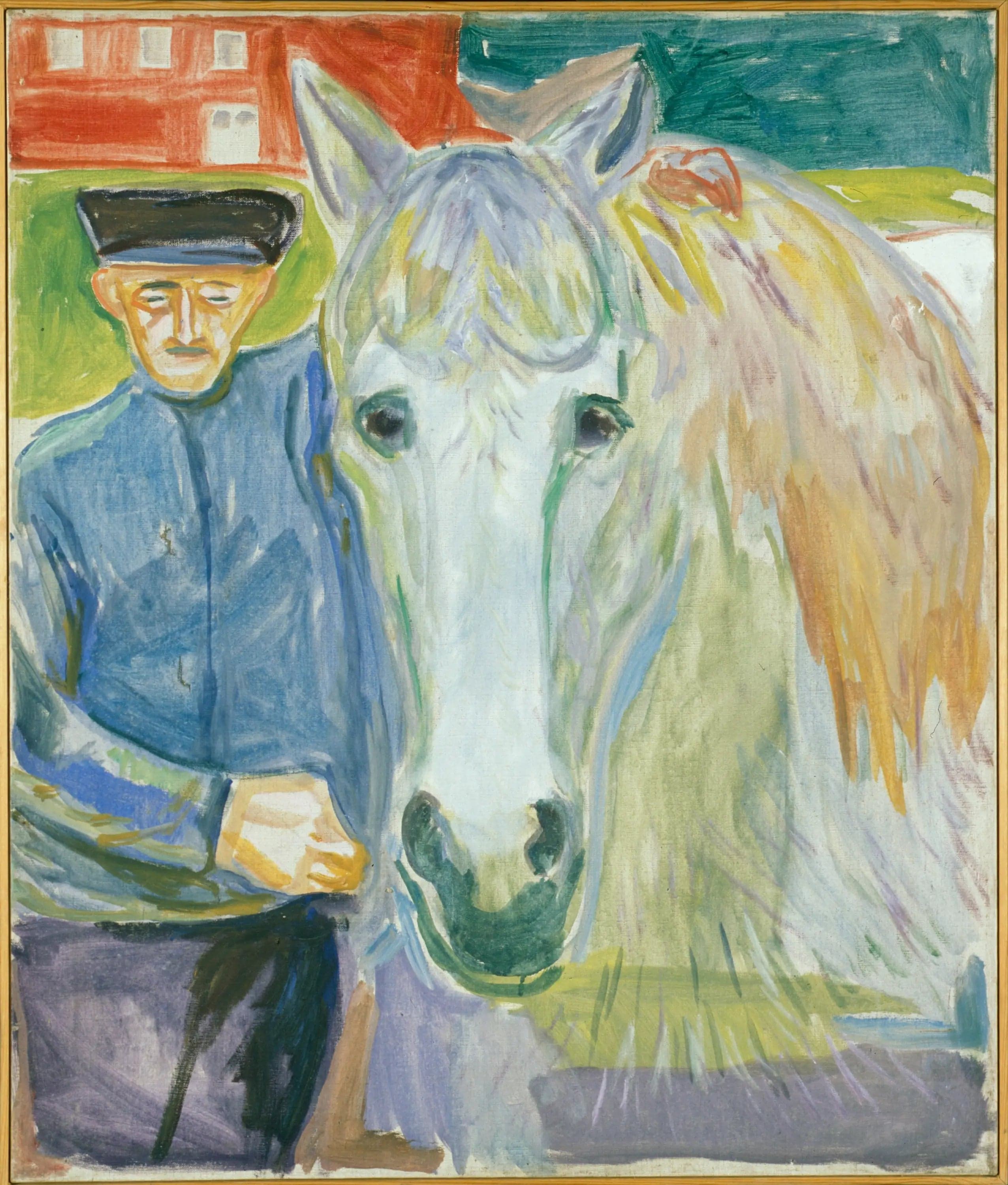
Man with a Horse
- Original dimensions
- 78 x 92.5 cm
- Museum
- Munch Museum
- Year
- 1932
Scene depicted
This painting tells the unbreakable bond between man and nature. The metaphor of the horse represents freedom, while the very human silhouette evokes the relationship to the land. Munch, through this painting , challenges us on isolation and belonging, recurring themes in his pictorial work.
Historical context
Painted in the 1930s in Oslo, this iconic work belongs to the expressionist movement of which Edvard Munch is one of the pioneers. In a context of cultural upheaval, Man with a Horse stands as a poignant testimony of the era. Currently, this painting is exhibited at the Munch Museum, where it continues to move entire generations.
Place in the artist's career
Man with a Horse is among Munch's great compositions, marking a period of maturity where the artist sublimates his technique. In parallel with The Scream and The Madonna , this work shows an evolution in palette and emotional expression that resonates deeply with the human experience.
Anecdote
“Horses, like souls, carry their history.” This quote perfectly summarizes the inspiration that emerged during the creation of Man with a Horse . One gentle morning, while strolling along the banks of Oslo, the artist encountered a man and his horse, a simple yet striking scene, both serene and unsettling, that illuminated his mind.
Major exhibitions
Munch og Ekely: 1916-1944