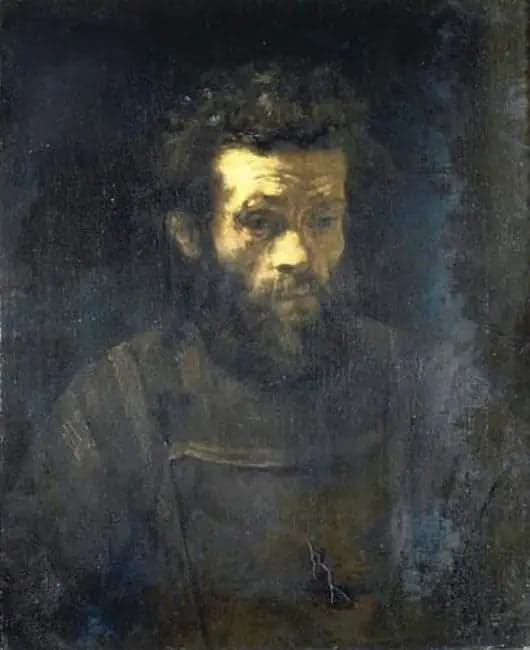
Man with a Beard
- Original dimensions
- 58 x 70.5 cm
- Museum
- Gemäldegalerie
- Year
- 1657
Scene depicted
In this painting , Rembrandt captures much more than just a face: he delivers a universal human experience. The man, with an intense gaze and deep reflection, seems to emerge from the shadows, as if the painting itself were telling a story of wisdom and experience. The light subtly illuminates his features, accentuating the texture of his beard and the depth of his eyes, a living painting that engages and fascinates.
Historical context
Created in 1657, this painting is emblematic of the baroque era, a period marked by its boldness and emotional imprint. Rembrandt , the Dutch master of light and shadow, stands out for a technique that captures human essence in all its complexity. Currently on display at the Gemäldegalerie in Berlin, the canvas measures 58 x 70.5 cm, an ideal format to embody the depth of a classic portrait.
Place in the artist's career
Situated at a turning point in his career, Man with a Beard testifies to Rembrandt's growing mastery of portraiture. Both contemplative and engaged, this masterpiece dialogues with other works such as “The Night Watch” and “The Jewish Wanderer,” where light and shadow elevate the human experience. This painting not only marks the maturity of the painter but also embodies his inimitable style.
Anecdote
“The human soul is the greatest of canvases ,” could have said Rembrandt while tackling his masterpiece. It was a foggy morning when Rembrandt found inspiration in the shadows of an Amsterdam alley, captivated by the face of a man with a full beard, a reflection of a rich life full of stories to tell. This painting thus becomes a testament to the intensity of the moment.