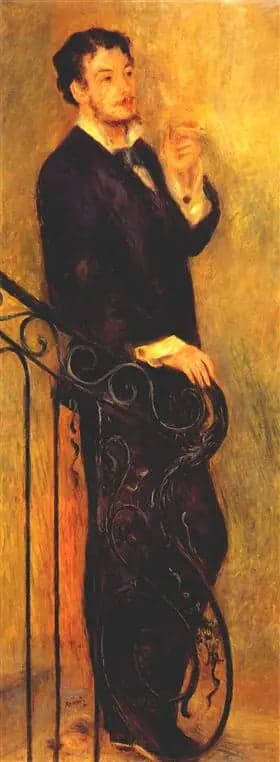
Man on a Staircase - Pierre
- Original dimensions
- 65.3 x 167.5 cm
- Museum
- Hermitage Museum
- Year
- 1876
Scene depicted
"Man on a Staircase" transports us to the heart of a lively scene, where the silhouette of a man, frozen in his movement, becomes the focal point of a vibrant composition. The stairs, both structural and symbolic, evoke the ascent towards a destiny or the descent into anonymity, reinforcing the narrative sense of this pictorial work .
Historical context
Created in 1876, during the Impressionist period, the painting "Man on a Staircase" is an iconic illustration of the artistic innovations of this time. In the vibrant setting of France, Renoir captures everyday life with a tactile and luminous approach. Today, this canvas is displayed at the Hermitage Museum , where its dimension of 65.3 x 167.5 cm continues to fascinate visitors with its dynamism and depth.
Place in the artist's career
This painting fits into a key moment in Renoir's career, where the artist freely experiments with Impressionist techniques. Compared to "Luncheon of the Boating Party" and "The Bather," "Man on a Staircase" reveals his stylistic evolution marked by an increasingly sophisticated play of light and color.
Anecdote
"Art should seek nothing but beauty," Renoir said. It is in a bustling alley on a spring morning that the artist is said to have drawn inspiration for this masterpiece . The movement of passersby, the play of light on the stairs, all become an ode to life, translated with palpable emotion in his painting .