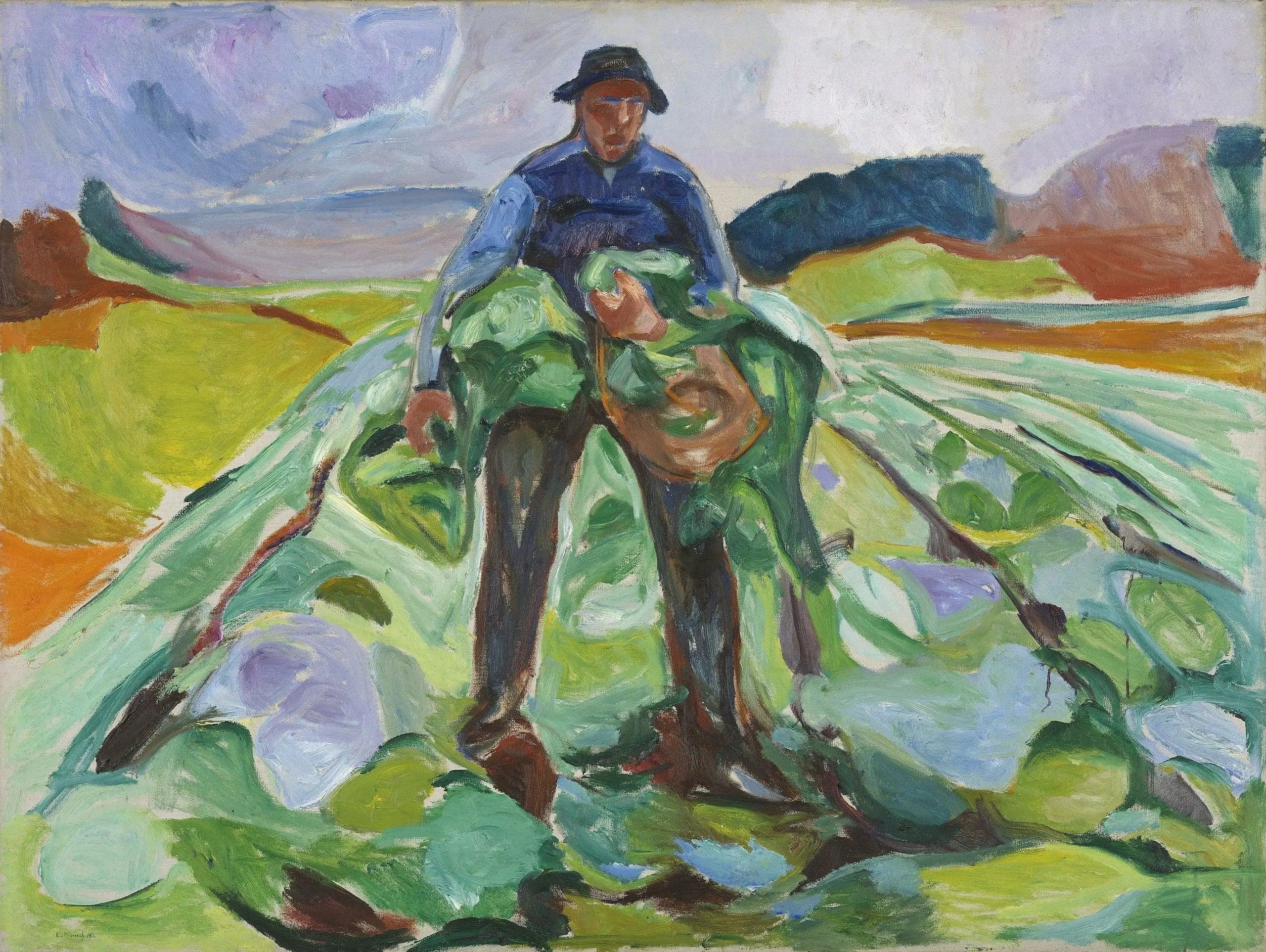
Man in the Cabbage Field
- Original dimensions
- 180 x 136 cm
- Museum
- National Gallery of Oslo
- Year
- 1916
Scene depicted
The painting “Man in the Cabbage Field” depicts a man, the central figure, standing among vibrant and lush green cabbages. The work of Edvard Munch transcends mere landscape to explore the human condition, establishing a fascinating dialogue between man and nature. This painting is a hymn to the quintessence of life, to the raw beauty that fills the earth and awakens the senses.
Historical context
Created in 1916, this painting emblematic of Edvard Munch was born in Oslo, in the heart of Norway. It captures the essence of the expressionist movement, a reflection of an era marked by emotional and artistic upheavals. Currently, this work is located at the National Gallery of Oslo, where it is carefully preserved. Its imposing dimensions of 180 x 136 cm give the canvas an even more striking presence.
Place in the artist's career
This painting is situated in a period of artistic maturity for Munch. It brilliantly fits between other major compositions such as “The Scream” and “The Madonna,” highlighting his evolution towards a more introspective and contemplative style. The connection between these works testifies to his ongoing exploration of human emotions through the canvas .
Anecdote
“Nature is my greatest muse.” Thus spoke Munch, confiding his inspiration to the serenity of Norway's green fields. It was on a morning with the sweet scents of fresh cabbage, illuminated by a shy sun, that the artist imagined the masterpiece that would become “Man in the Cabbage Field.” A meeting with rural life, imbued with authenticity and simplicity.
Major exhibitions
Edvard Munch . Monumental projects