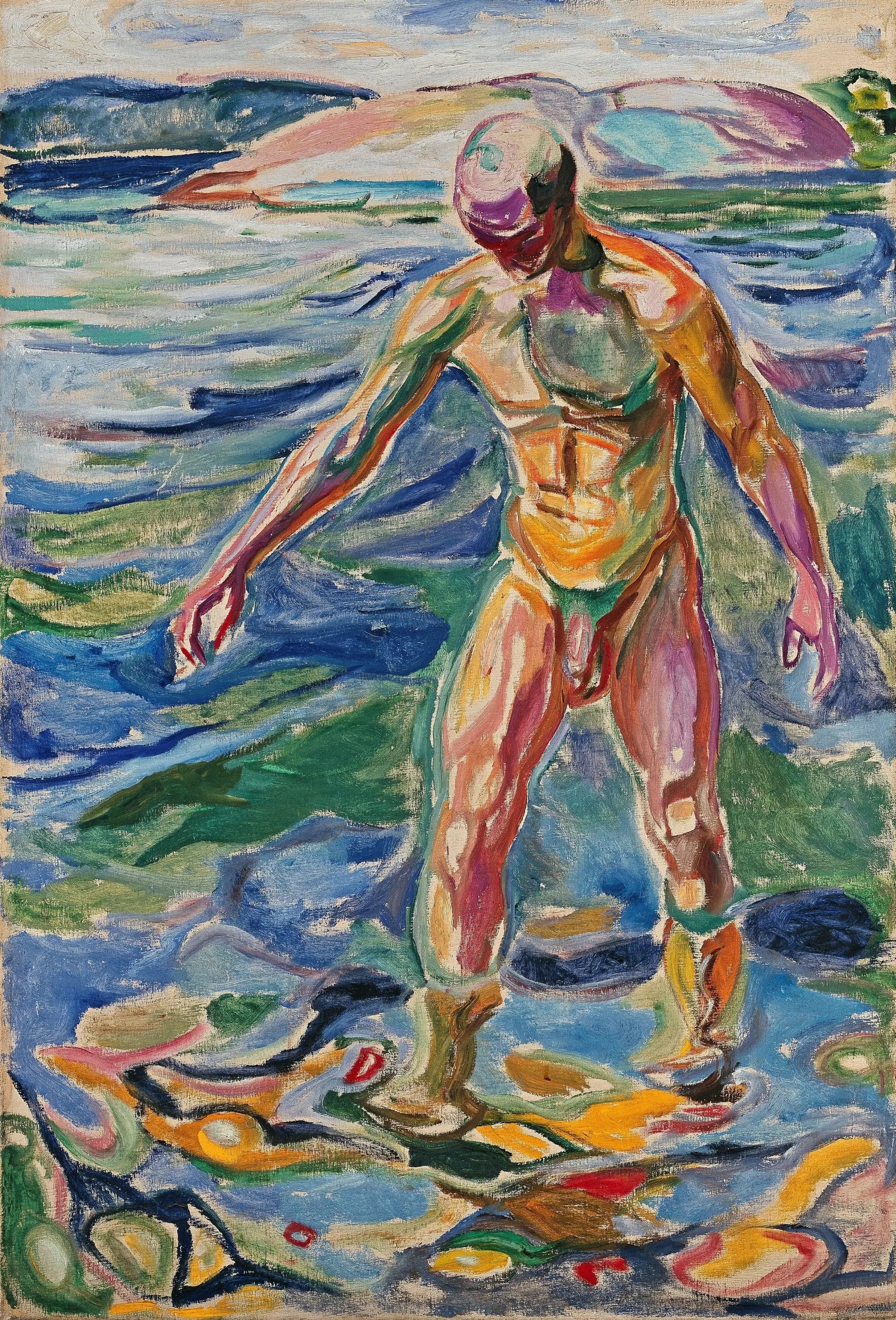
Man Bathing
- Original dimensions
- 110 x 160 cm
- Museum
- National Gallery of Oslo
- Year
- 1918
Scene depicted
This canvas constitutes a captivating visual narrative, where a man surrenders to the water, floating between dream and reality. The human figure, both vulnerable and strong, immerses itself in a world of intense sensations. The waves whisper a soft melody, and the sparkling light seems to whisper forgotten secrets. Every detail of this canvas tells a silent story, a quest for inner peace.
Historical context
Created in 1918, in Oslo, this iconic symbolist painting is situated at the crossroads of artistic movements of the early 20th century. In a post-war context, Edvard Munch , a major artist of symbolism , captures the fragility of human existence. This masterful canvas is currently displayed at the National Gallery of Oslo, where it attracts the gaze and reflections of art lovers around the world.
Place in the artist's career
Positioned within the prolific career of Edvard Munch , the painting “Man Bathing” marks a significant evolution in his exploration of the human spirit. As part of a stylistic maturation, two other canvases , such as “The Madonna” and “The Scream,” illustrate the continuity of his themes related to existence, death, and love. This pictorial work embodies an essential milestone, revealing a more refined technique and enhanced expressiveness.
Anecdote
“I want to paint life, life in all its nuances.” Munch might have whispered these words by the edge of a peaceful lake, absorbing the light of a summer morning. It is in this serene place that he drew inspiration for his painting . The composition of Man Bathing resonates with immense emotional strength, evoking the emergence of human consciousness in nature.