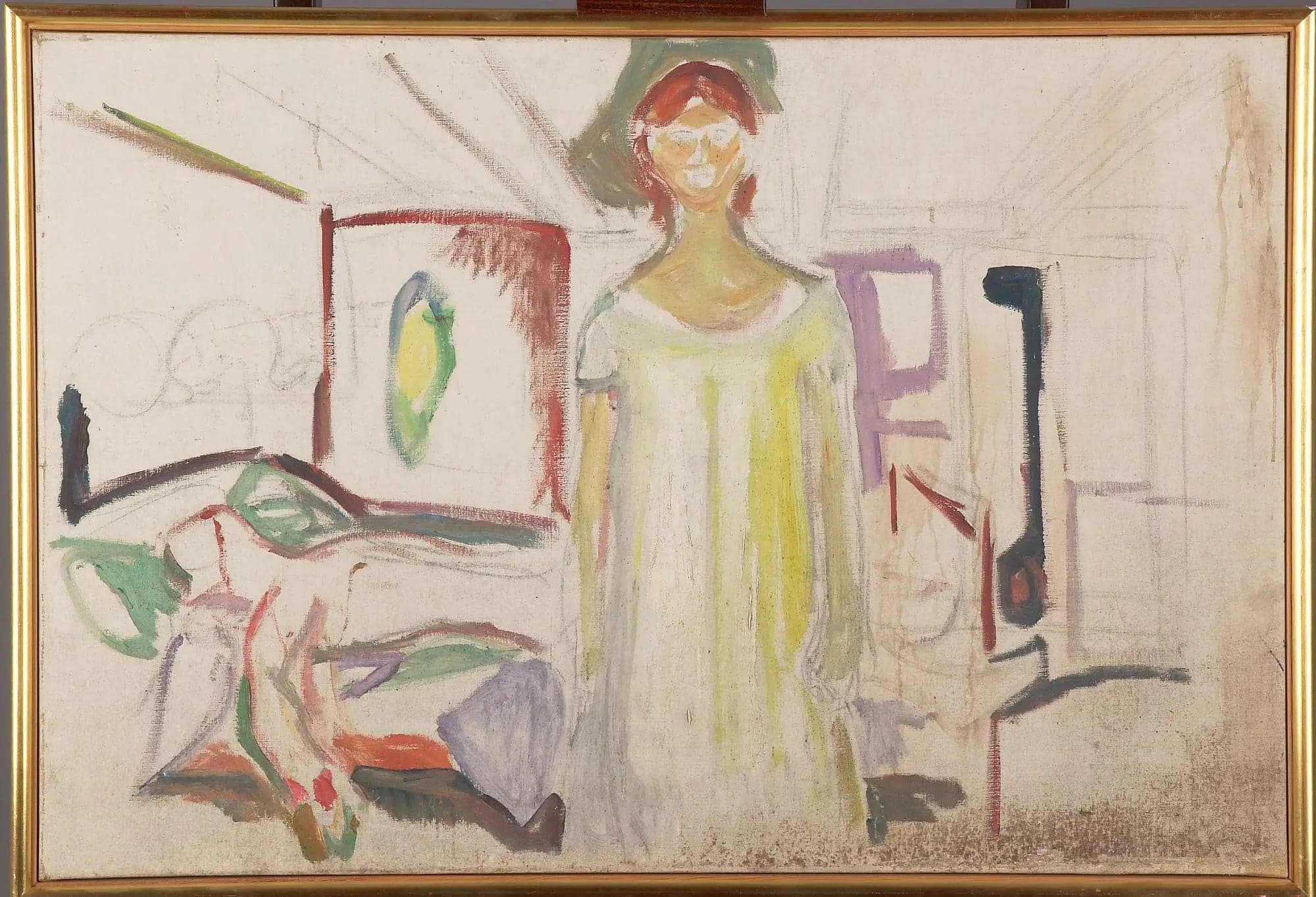
Man and Woman
- Original dimensions
- 100.5 x 60.8 cm
- Museum
- Bergen Art Museum
- Year
- 1898
Scene depicted
In this canvas , Munch evokes the complexity of romantic relationships, representing a man and a woman in a vibrant composition of emotions. As they stand on the threshold of an invisible world, their posture and gaze convey an intimacy troubled by doubts and desire, creating an atmosphere that is both captivating and unsettling.
Historical context
Created in 1898, in the bubbling context of the late 19th century in Oslo, the painting "Man and Woman" is part of the expressionist movement, an artistic current that explores deep emotional turmoil and the complex relationships between man and woman. This canvas , exhibited at the Bergen Art Museum, reflects the harshness of human relationships, placed at the heart of an era marked by significant social and cultural changes.
Place in the artist's career
"Man and Woman" positions itself at a turning point in an already rich career. This painting marks a period of stylistic maturation for Munch, followed by compositions such as "The Scream" and "The Madonna," where the artist explores with greater intensity the depths of the human condition and feeling.
Anecdote
Edvard Munch , this great explorer of human emotions, once said: "I paint not what I see, but what I feel." This quote resonates deeply with the painting "Man and Woman," which captures the brutal essence of love, between passion and melancholy, imagined on a misty morning, as a diffuse light illuminated a silent street.