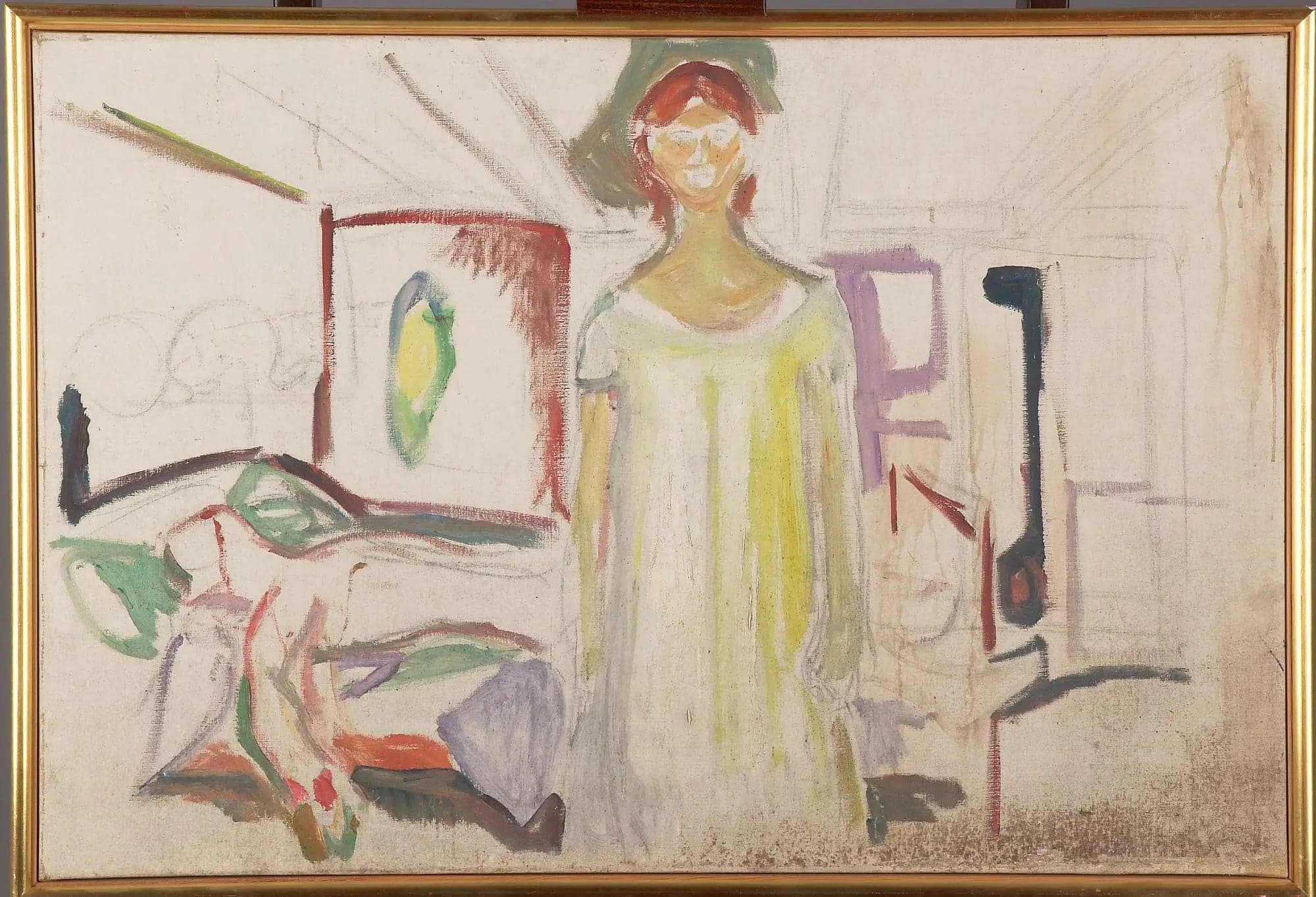
Man and Woman
- Original dimensions
- 115.5 x 89.5 cm
- Museum
- Munch Museum
- Year
- 1913
Scene depicted
This canvas depicts the meeting between a man and a woman, a moment sublimely charged with emotions. Their forms, both distinct and intertwined, illustrate the complexity of human relationships: a fragile balance between attraction and withdrawal, where non-verbal language takes precedence over words.
Historical context
Created in 1913, in the city of Oslo, then still called Christiania, this sublime painting is part of the expressionist movement, resonating with the turmoil of post-war society. The pictorial work is now located at the Munch Museum, where it attracts art admirers from around the world, captivated by its imposing dimensions.
Place in the artist's career
Man and Woman is at the heart of Munch's career, illustrating his mastery of visual language. While his early paintings , such as “The Scream,” express suffering, this work represents a peak of his reflection on love and human interaction, akin to “The Madonna,” which also questions passion and loss.
Anecdote
“Every brushstroke is a cry of the soul,” Munch might have said as he immersed himself in the creation of his masterpiece . One awakening morning, cradled by the song of birds and the soft light filtering through the branches, the artist found inspiration in observing the silhouettes of a man and a woman, symbolizing love and disillusionment.
Major exhibitions
Edvard Munch and his models: 1912-1943