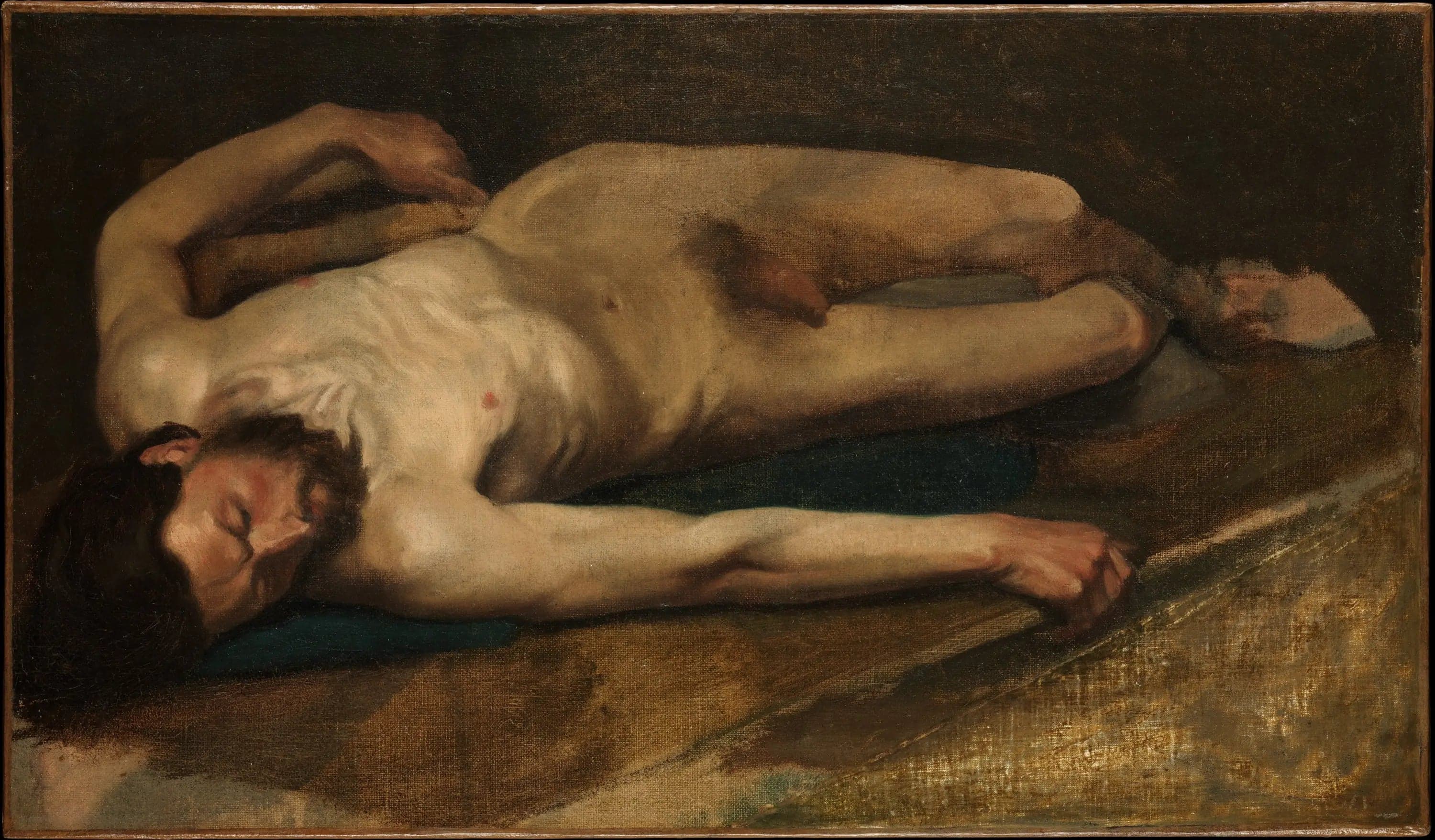
Male Nude
- Original dimensions
- 61.6 x 34.9 cm
- Museum
- Metropolitan Museum of Art
- Year
- 1856
Scene depicted
The scene of the painting “Male Nude - Edgar Degas ” captures attention with its boldness and the delicacy of its execution. The male nude, not only a subject often taboo, becomes here revealing of a raw and elegant beauty, where nudity mingles with a sense of vulnerability. This creates a palpable tension, emanating from the static idleness, accentuated by the way light caresses the skin, sublimating the pictorial work.
Historical context
Created in 1856, in the city of Paris, Male Nude is part of the Impressionist movement, although it is often considered a precursor to this movement. At that time, Paris is the nerve center of art, where new artistic ideas come to life and where iconic figures like Degas disrupt the landscape of painting . Currently, this painting is exhibited at the Metropolitan Museum of Art in New York, measuring 61.6 x 34.9 cm, it testifies to the expertise and vision of its creator.
Place in the artist's career
Male Nude represents one of Degas's first explorations in the field of nudes, marking his anchoring in an artistic tradition while foreshadowing his future path. In his subsequent works, such as The Dancer at Rest and The Ballet Scene , an evolution in technique and expressiveness of his characters can be observed, while maintaining the same empathetic gaze on the human body.
Anecdote
“Light must work, like an actor, every time it unfolds,” could have said Edgar Degas one spring morning in his sunny studio. This moment of inspiration would mark the creation of this masterpiece , a painting revealing a standing male nude, its elegantly sculpted silhouette exposing the human texture under subtly modulated lighting.