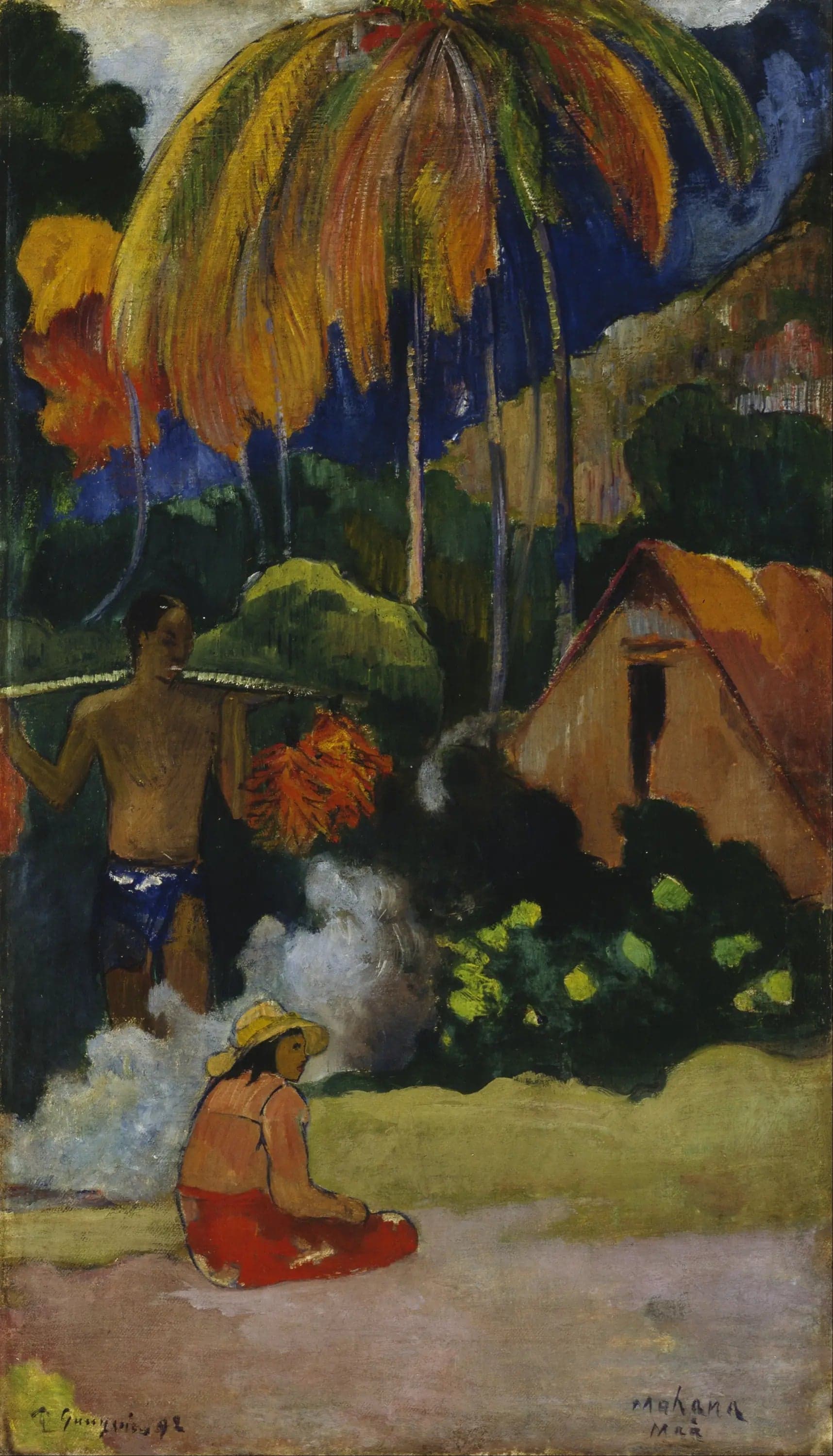
Mahana Maà
- Original dimensions
- 31 x 54.5 cm
- Museum
- Ateneum Art Museum
- Year
- 1892
Scene depicted
"Mahana Maà" depicts a moment of Polynesian daily life, leading the gaze towards women resting on the shore, their forms harmoniously intertwining with the landscape. The composition evokes not only the tranquility of nature but also a form of spiritual communion between man and his environment, revealing the very essence of this canvas .
Historical context
Created in 1892, during his stay in Polynesia, the painting "Mahana Maà" represents a key moment in the work of Paul Gauguin , fitting into the Post-Impressionist movement. This canvas reflects his desire to capture wild beauty and exotic cultural influences. Currently, this painting is located at the Ateneum Art Museum, reminding everyone of the magic of his time.
Place in the artist's career
Positioned at the heart of Gauguin's career, this painting is both a culmination and a departure. The fleeting scent of tropical flowers, reminiscent of other works like "The Yellow Christ" and "The Card Players", unveils his stylistic evolution towards hieratic and colorful expression, marking a decisive step in his doubtful and fascinating exploration of oceanic cultures.
Anecdote
“I seek color where it sings the loudest.” This phrase resonates as an echo of the inspiration that gave birth to the painting "Mahana Maà". Imagining Gauguin on a golden beach, breathing in the air filled with floral and ocean scents, gives a soul to this masterpiece , enveloping the viewer in an almost palpable serenity.