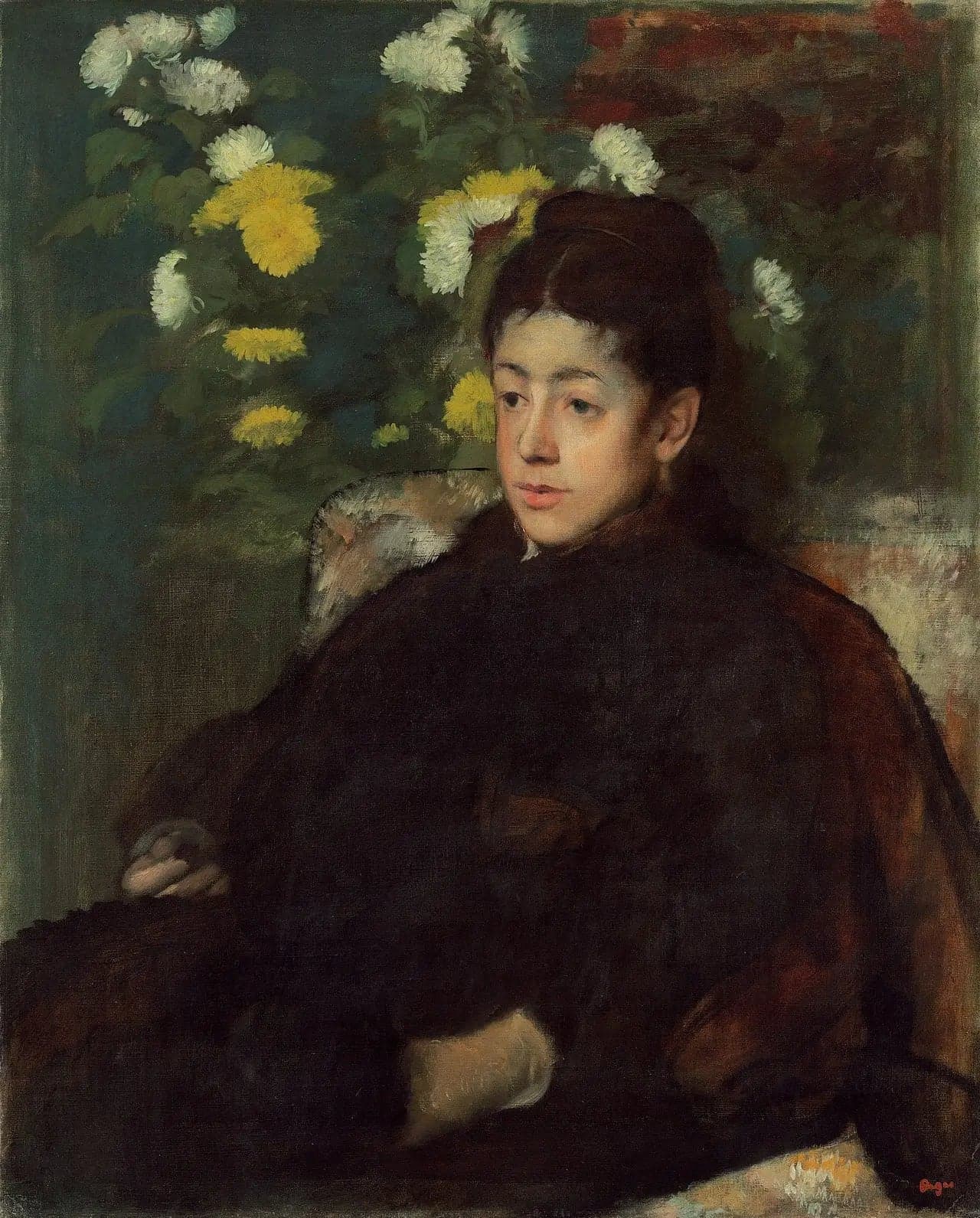
Mademoiselle Malo
- Original dimensions
- 65.1 x 81.1 cm
- Museum
- National Gallery of Art
- Year
- 1877
Scene depicted
The painting Mademoiselle Malo features a young woman with a pensive and melancholic gaze. This painting reveals her natural elegance, highlighted by delicate shades that evoke the soft light of a Parisian interior. The subtle play of shadows and light in the canvas gives an almost tangible dimension to the contemplative atmosphere that emanates from the painting.
Historical context
Created in 1877, during a bubbling period of artistic creativity in Paris, the painting Mademoiselle Malo finds its place in the impressionist movement, although Degas often diverges from it in his approach. This canvas , currently preserved at the National Gallery of Art , Laboureur in the heart of Paris, illustrates the vibrant cultural climate of the Belle Époque, where art becomes the expression of modernity. Measuring 65.1 x 81.1 cm, this major work testifies to the excellence and dynamism of the era.
Place in the artist's career
Mademoiselle Malo marks a turning point in Degas's career, illustrating his shift towards more introspective themes. Unlike his earlier works that emphasized movement, such as The Dancers , this painting reflects a more intimate and personal approach. A piece like The Girl with the Parrot already shows advanced technique, while the painting Mademoiselle Malo deepens this evolution.
Anecdote
Edgar Degas once stated: “Painting is an act of capturing the moment, an imprint of the human soul.” In Mademoiselle Malo , the artist captures not only the face of his model but also the atmosphere of a bygone afternoon, bathed in light and promises. Inspired by a meeting in a Parisian café, he transcribes this emotional momentum through the vibrant strength of his composition .