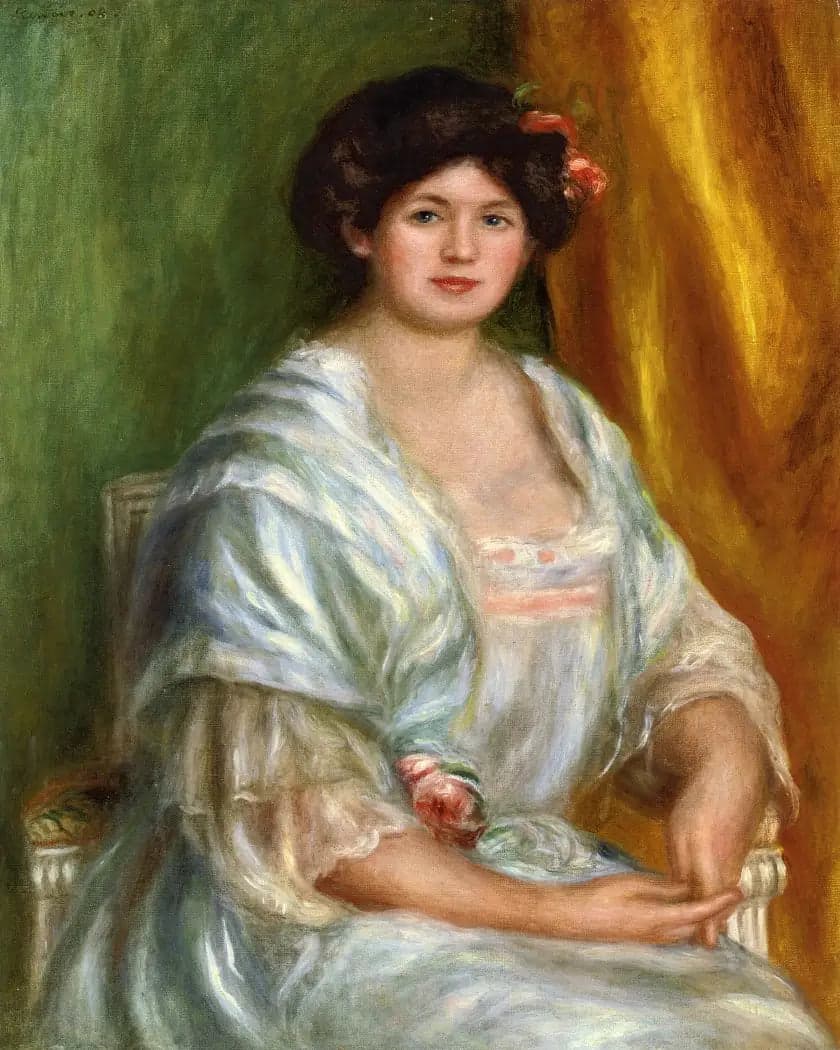
Madame Thurneyssen - Pierre
- Original dimensions
- 65.5 x 82.5 cm
- Museum
- Not specified
- Year
- 1908
Scene depicted
In Madame Thurneyssen , we discover the face of an elegant woman, revealing through her gaze a depth of emotion. Through her graceful bearing and serene posture, this painting celebrates not only external beauty but also the inner life of her model. It is an invitation to scrutinize the mysteries of the human soul, where each brushstroke translates a sensitive fiber, harboring memories, desires, and aspirations. The work unfolds like a visual narrative where every detail matters.
Historical context
Created in 1908, at the crossroads of Impressionist influences, the painting Madame Thurneyssen embodies the vibrant spirit of the Belle Époque in France. Set in a revolutionary artistic context, this canvas reflects the unique atmosphere of this era. This painting , now at the heart of a private collection, evokes the artistic encounters within the Impressionist movement, capturing the ephemeral beauty of a time marked by elegance and innovation. With dimensions of 65.5 x 82.5 cm, it promises to enchant art enthusiasts.
Place in the artist's career
Madame Thurneyssen is situated at a pivotal point in the career of Auguste Renoir , marking a period of full maturity. Alongside Déjeuner des canotiers (1880) and La danse à la ville (1883), this canvas illustrates the evolution of his style. Renoir refines his technique, combining fine details with a vibrant palette, demonstrating an increasing mastery of human emotions on canvas.
Anecdote
Renoir once said: "The beauty of a woman is not simply in her appearance, but in the emotion she inspires." Inspired during a sunny walk in Paris, the moment of creating Madame Thurneyssen resonates as an ode to femininity and love, a vision immortalized in this iconic painting . Reminiscing these moments of grace, Renoir manages to convey an atmosphere imbued with sweetness and serenity through this composition.