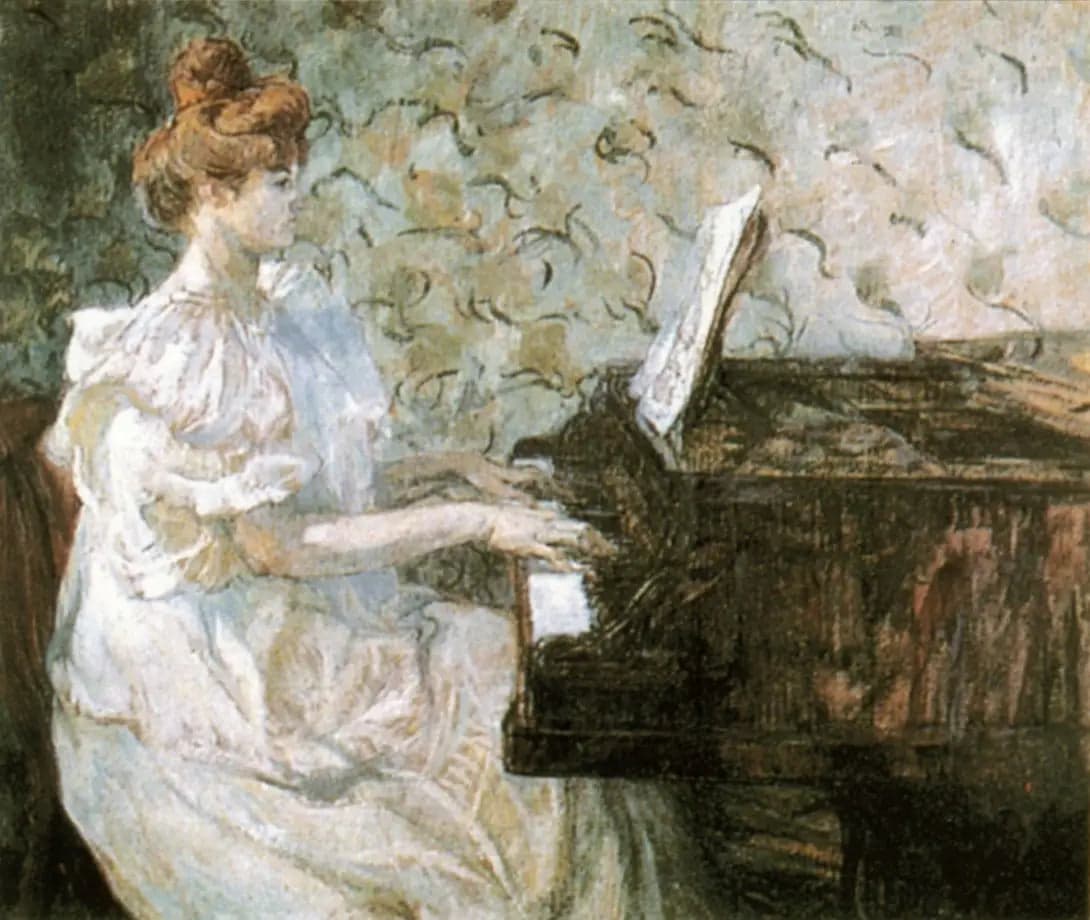
Madame Misia Natanson at the piano - Henri de Toulouse
- Original dimensions
- 96 x 82 cm
- Museum
- Bern Museum of Fine Arts
- Year
- 1897
Scene depicted
In this pictorial work, the scene depicts the famous patron and pianist, Madame Misia Natanson, immersed in her music. Toulouse-Lautrec succeeds in capturing not only the appearance of the musician but also the vibrant energy of the moment. Her captivated gaze and the notes that seem to float around her illustrate the fusion between art and life, an essence dear to the artist.
Historical context
This oil painting was created in 1897, in Paris, a city in full artistic effervescence, symbol of the post-impressionist movement. In this rich cultural context, Henri de Toulouse-Lautrec , an iconic figure, immortalizes moments of Parisian life with a unique sensitivity. Today, the painting is preserved at the Bern Museum of Fine Arts , where it continues to inspire generations of admirers.
Place in the artist's career
Madame Misia Natanson at the piano represents a pivotal moment in Toulouse-Lautrec's career. As he asserts himself at the peak of his style, two other paintings — “The café concert” and “The dance at the Moulin Rouge” — show the evolution of a technique, blending color spots and bold brush strokes to involve the viewer in the Parisian arena.
Anecdote
Henri de Toulouse-Lautrec once declared, while observing an artistic gathering in a Parisian café: “It is not so much the subject that matters, but the emotion we derive from it.” It is this quest for emotion that shines through in the painting of Madame Misia Natanson, as she loses herself in the melody of her piano, lost in a moment of intense creativity.