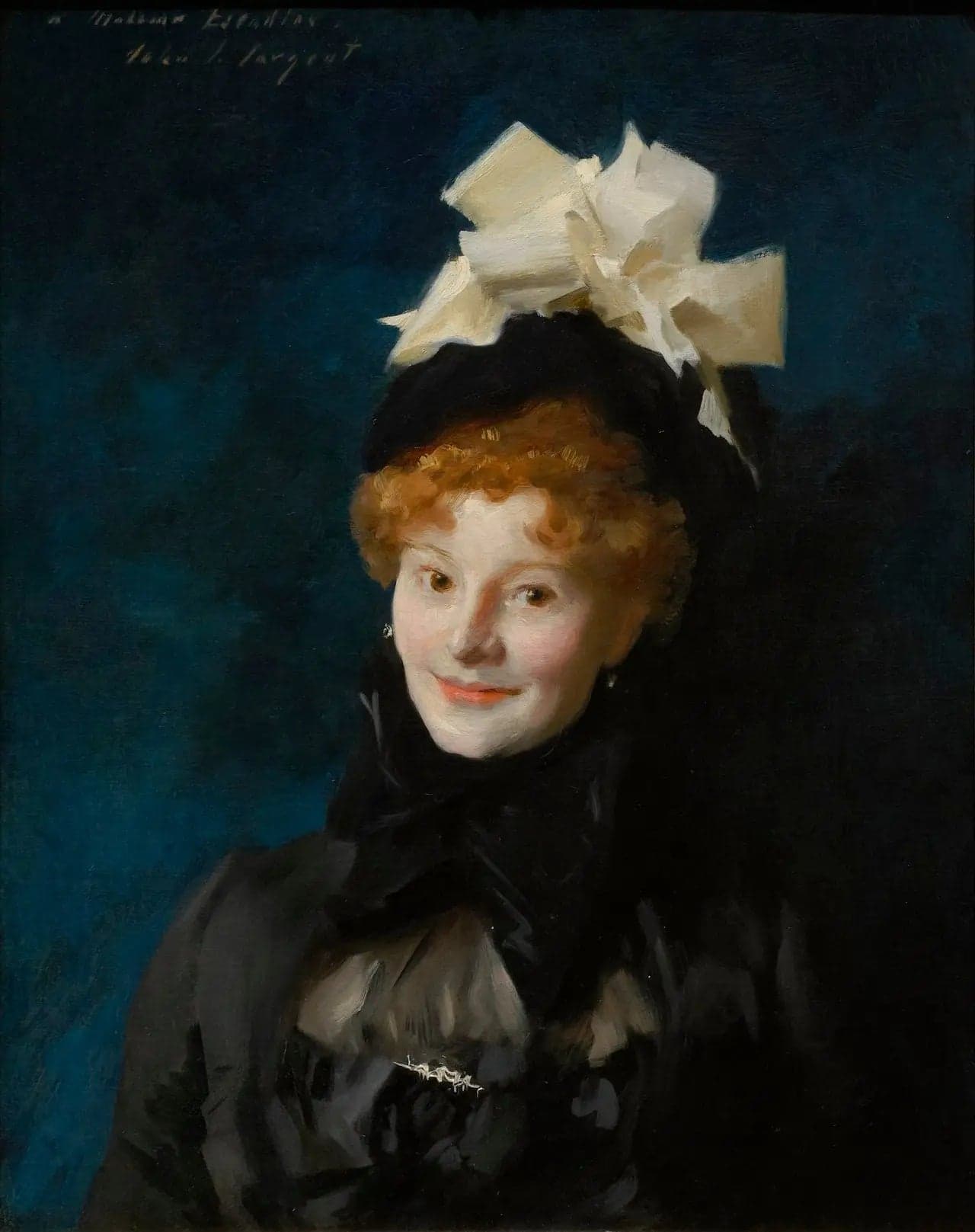
Madame Escudier
- Original dimensions
- 59.5 x 73.2 cm
- Museum
- Clark Art Institute
- Year
- 1883
Scene depicted
“Madame Escudier” represents the wife of the French art collector Paul Escudier, wrapped in elegant drapery, with a gaze that seems to pierce through time. Sargent succeeds in capturing the complexity of her mind and the richness of her social status, while revealing a depth of emotion. The painting is a subtle exploration of the modern woman at this turn of the century, a symbol of power and intellect.
Historical context
Created in 1883, at the crossroads between the end of the 19th century and the emergence of modernist movements, this painting is currently located at the Clark Art Institute , in Williamstown, Massachusetts. In a context where realism begins to coexist with impressionism , Sargent develops his own pictorial language, combining finesse and light. This canvas is a sublimation of the elegance and refinement of a bygone era, through the representation of Madame Escudier.
Place in the artist's career
“Madame Escudier” stands as a pillar in Sargent's career, a revealing work of his artistic maturity. After his debut on the Parisian scene and before his grand portraits such as “Carnation, Lily, Lily, Rose”, this painting highlights his technical evolution, merging the precision of portraiture with an intimate and warm atmosphere.
Anecdote
John Singer Sargent once stated: "Every face has its own story to tell, its own secrets to reveal." A reflection that finds its essence in the canvas of Madame Escudier. This precise moment when he captured his model, in soft light, illustrates the genius of the artist, capable of rendering the soul of a person into a vibrant pictorial work .