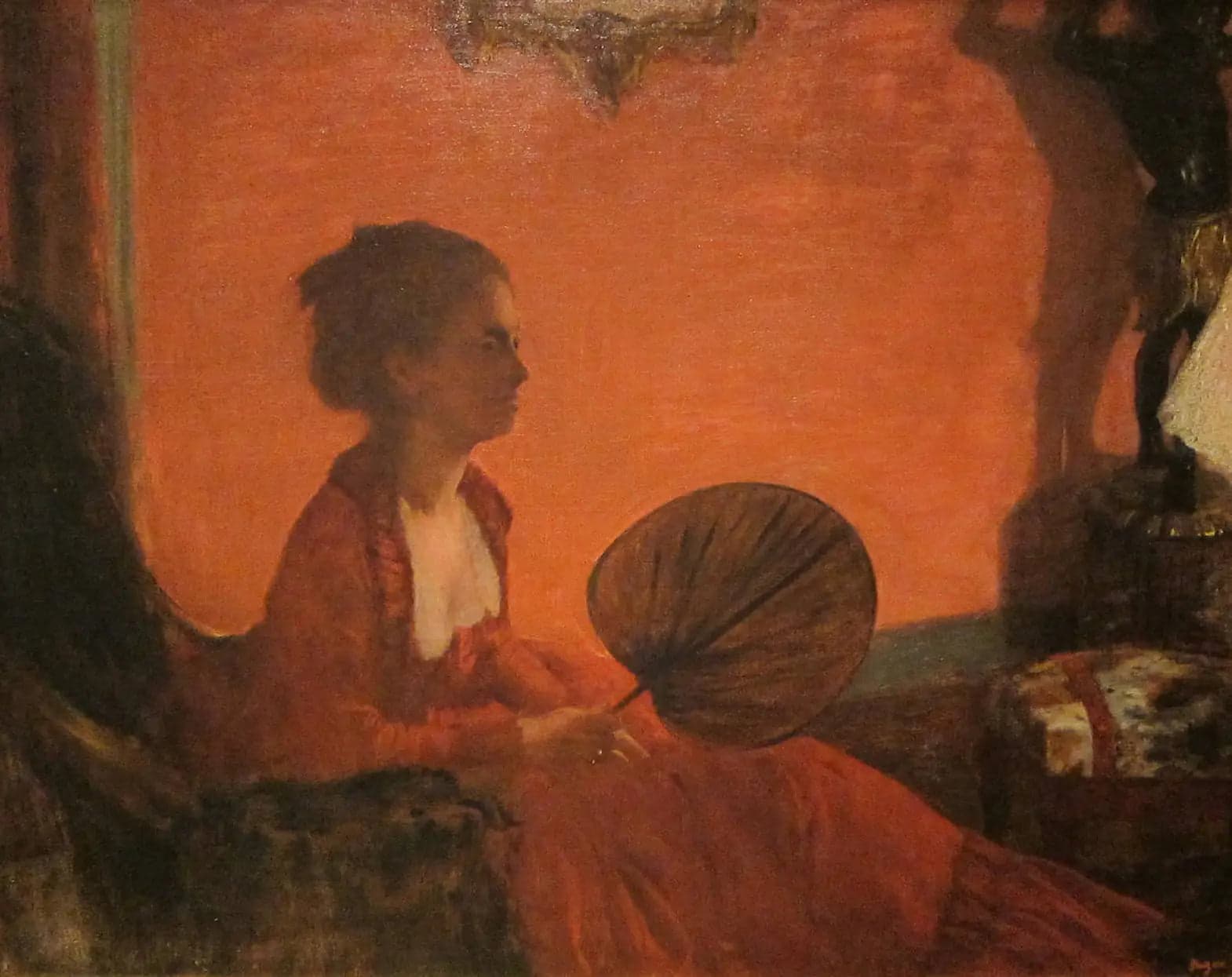
Madame Camus
- Original dimensions
- 92.1 x 72.7 cm
- Museum
- National Gallery of Art
- Year
- 1869
Scene depicted
In this canvas , Degas captures the essence of femininity through the portrait of Madame Camus. The central figure, elegantly dressed, seems to contemplate an invisible world, reflecting an introspection of unparalleled beauty. Every detail, from the texture of the fabric to the tired gleam of her gaze, testifies to a profound pictorial narrative.
Historical context
Created in 1869 in the heart of Paris, this painting is emblematic of the Impressionist movement. At that time, artists sought to capture light and movement, moving away from academic conventions. The current canvas is displayed at the National Gallery of Art , where it continues to amaze visitors.
Place in the artist's career
This painting sits at the crossroads of a period of maturity for Degas. While "The Dance Class" and "L'Absinthe" reveal his affection for urban life, "Madame Camus" subtly illustrates the evolution of his search for movement and emotion. This work expresses an increased sensitivity towards his portraits, consolidating his place in the art world.
Anecdote
Degas once stated: "Beauty is everywhere, you just have to open your eyes." It was perhaps one spring morning, in a Parisian café buzzing with life, that he caught sight of Madame Camus. This fleeting moment was the breath of life of this pictorial work , where each brushstroke tells a story of euphoria and contemplation.