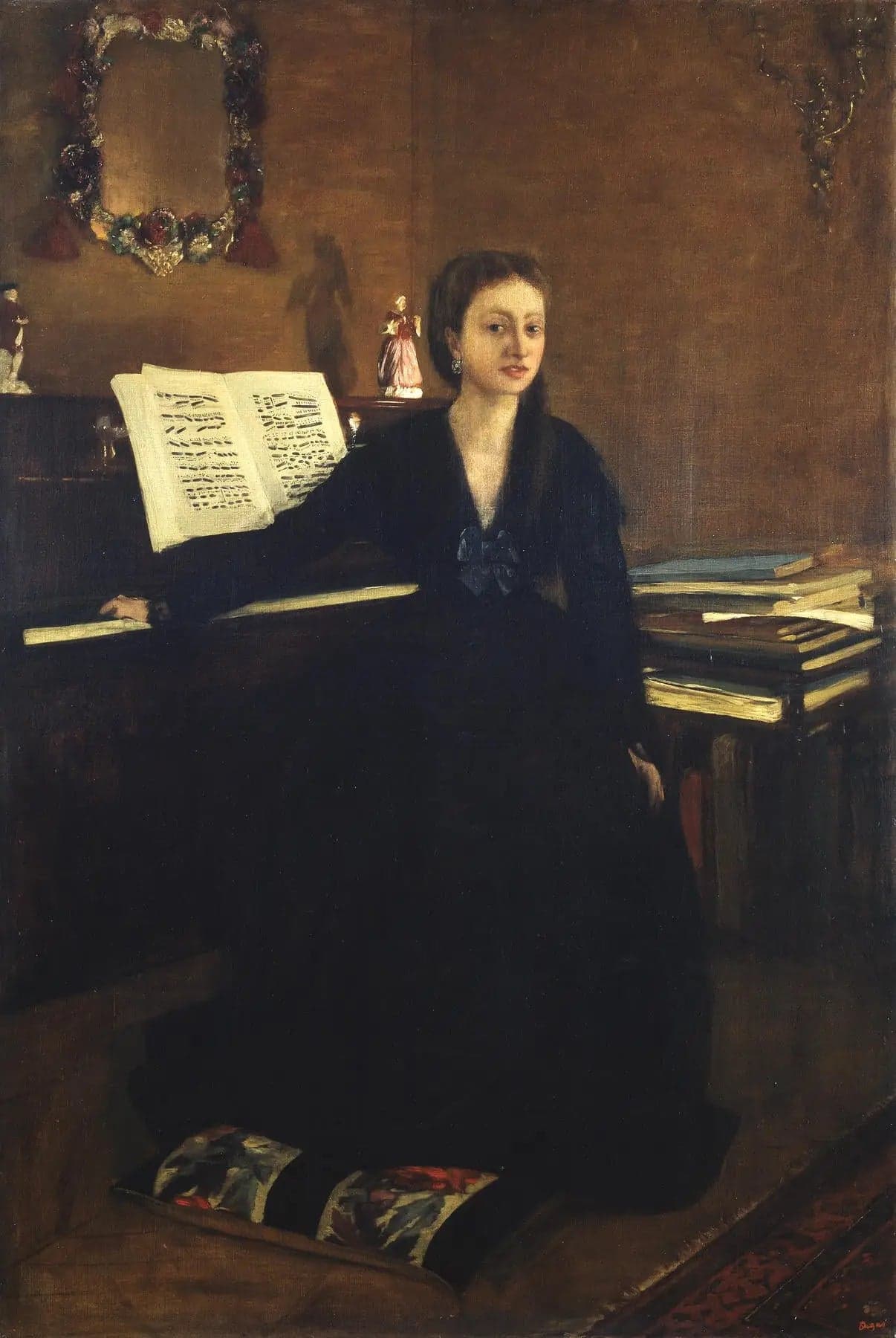
Madame Camus at the Piano
- Original dimensions
- 94 x 139 cm
- Museum
- Emil G. Bührle Foundation and Collection
- Year
- 1869
Scene depicted
This painting represents the artist's wife, enveloped in her notes, in a scene where the piano becomes the beating heart of the composition. She is immersed in a melody, while shadows dance around her, creating an atmosphere of tranquility mixed with intensity. The light plays with the textures, inviting the viewer to feel this elegant simplicity.
Historical context
Created in 1869 in Paris, this canvas is emblematic of the Impressionist movement. In a France experiencing artistic fervor, Madame Camus at the piano echoes the intimacy of Parisian salons, where music and art intertwine. Currently, this painting is preserved at the Emil G. Bührle Foundation and Collection , a true sanctuary for art enthusiasts.
Place in the artist's career
Positioning Madame Camus at the piano as a pivotal work, this painting reflects a period of maturation for Degas, between realism and Impressionism . Compared to Dancers at Rest and The Café Concert , it illustrates an evolution towards more intimate and introspective compositions, where each brushstroke of paint tells a story.
Anecdote
“Beauty lies in the captured moment,” said Edgar Degas . Inspired by a gentle spring morning, he observed Madame Camus at her piano, a moment suspended in time, rich with promises of musical and visual harmony. The painting resonates with this emotion, forever capturing the poetry of everyday life.