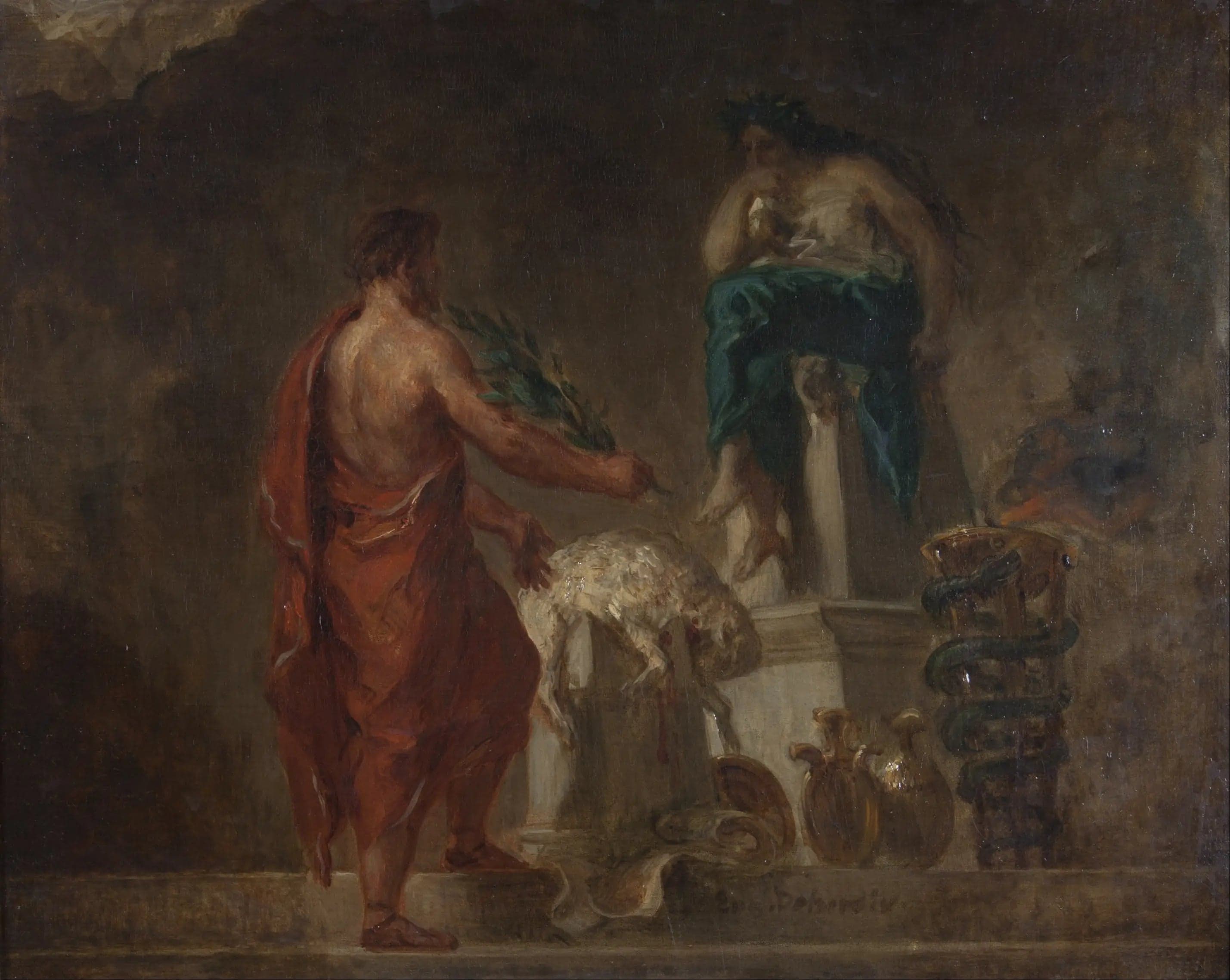
Lycurgus Consults the Pythia
- Original dimensions
- 41 x 33 cm
- Museum
- University of Michigan Museum of Art
- Year
- 1840
Scene depicted
This painting illustrates a dramatic moment from Greek mythology: Lycurgus, king of Thrace, consults the Pythia to know the fate of his kingdom. Illuminated by mysterious light, the setting, populated by symbolic figures, immerses us in a mystical universe where the uncertainty of the future collides with the wisdom of the ancients. The work reveals a moment of narrative tension, capturing the very essence of human destiny.
Historical context
Created in 1840, this painting is set at the edge of a bustling Paris, caught between the shadows and lights of Romanticism , the movement to which it belongs. Remarkably preserved, the work is now housed in the University of Michigan Museum of Art, a cultural gem within one of the most beautiful cities in the United States. Its intimate format of 41 x 33 cm gives this canvas an almost personal presence, like a window into eternity.
Place in the artist's career
“Lycurgus Consults the Pythia” marks an important milestone in Delacroix's career, illustrating his mature and innovative style. Compared to his other major works, such as “ Liberty Leading the People ” and “ The Death of Sardanapalus ”, this painting shows a technical and emotional evolution, oscillating between romantic passion and a refined mastery of compositions.
Anecdote
“I paint what I feel, what touches me deeply,” is said to have been uttered by Eugène Delacroix , inspired by the majesty of emotional storms. The idea of painting sprang forth one morning when he crossed the silhouette of a spectator in a muted, mysterious space. This raw energy finds a powerful echo in the expressive strength of the canvas .