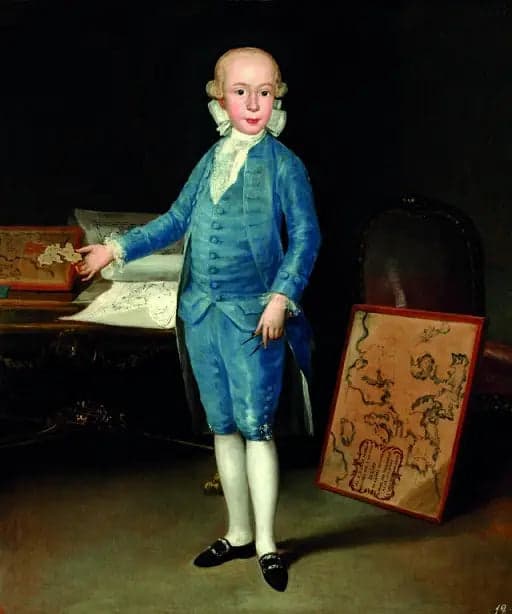
Luis María de Bourbon and Vallabriga
- Original dimensions
- 126 x 147 cm
- Museum
- Museum of Zaragoza
- Year
- 1783
Scene depicted
The painting “Luis María de Bourbón et Vallabriga” captures the essence of the Spanish aristocracy through a striking portrait. In a majestic pose, the noble surrounded by symbols of wealth and culture, he embodies the power of an era and reveals the subtleties of social life in the 18th century. Goya captures not only features but also a philosophy. Every detail contributes to a vibrant narrative that the viewer can feel.
Historical context
Created in 1783, this remarkable work comes to life in Zaragoza, a Spanish city in the heart of Aragon. The canvas is part of the early romanticism artistic movement, revealing a time of intellectual and artistic transformations. Currently exhibited at the Museum of Zaragoza, the painting unfolds majestically, measuring 126 x 147 cm, embodying the essence of an era where emotion took precedence over reason.
Place in the artist's career
This painting stands as a pivot in Goya's career, a symbol of his artistic development and his liberation from conventions. Alongside other iconic works such as “The Sleep of Reason Produces Monsters” and “La Maja Desnuda,” this painting illustrates his quest for emotional and aesthetic truth, using a rich and expressive color palette.
Anecdote
“Every brushstroke is a dance of the soul,” said Goya, evoking the emotional intensity behind his masterpiece. Imagine him, one spring morning, facing a blue sky and the shimmering light illuminating a face, this fleeting moment nourishing the inspiration for the painting we admire today.