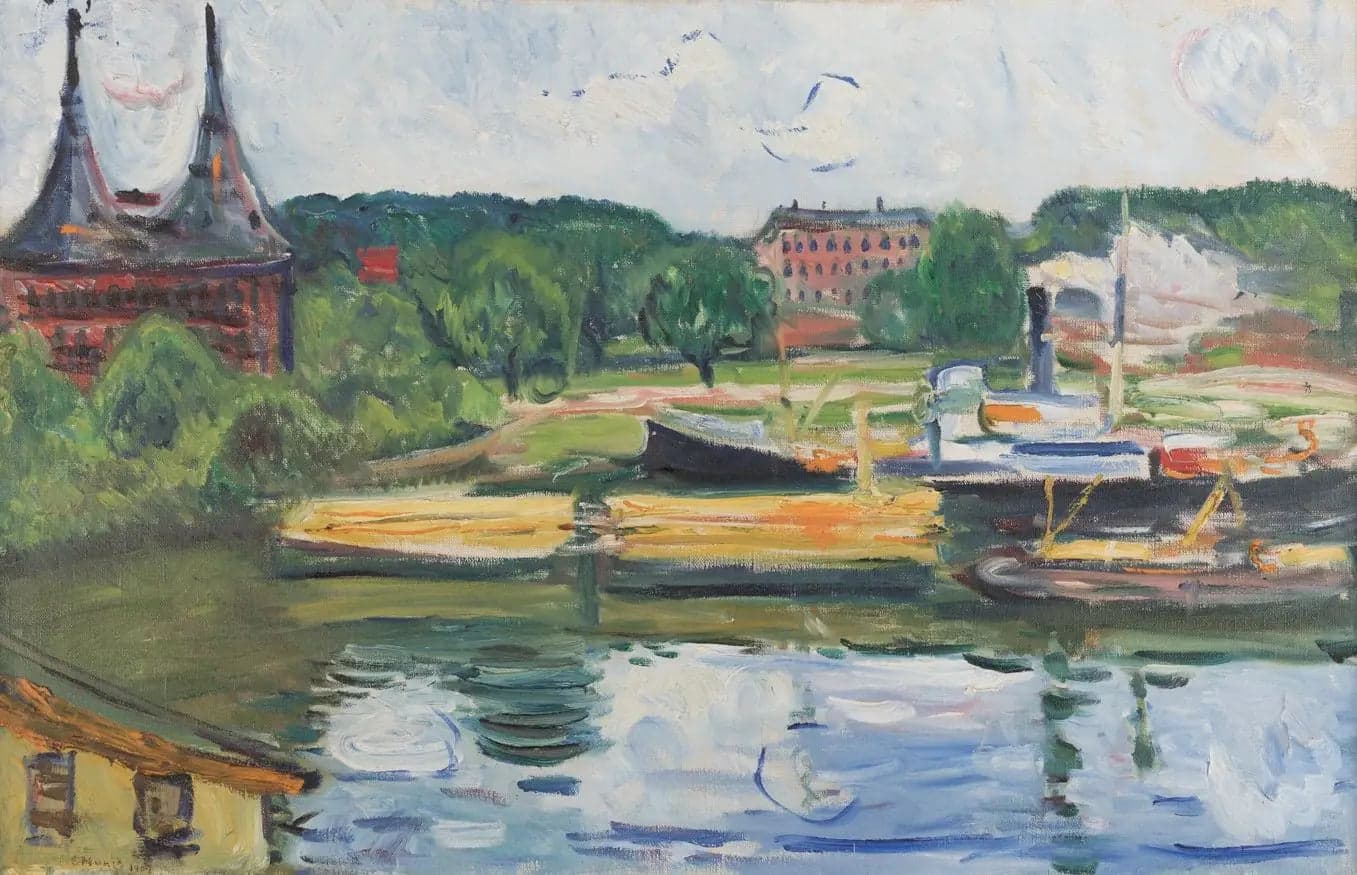
Lübeck with the Holstentor
- Original dimensions
- 130 x 84 cm
- Museum
- Neue Nationalgalerie
- Year
- 1907
Scene depicted
The painting "Lübeck with the Holstentor" transports us to the heart of a vibrant Lübeck, where the rays of the sun reflect on the Gothic structures. The artist, using saturated colors and bold shapes, reveals not only the iconic architecture but also the essence of an era, thus merging past and present into a striking visual experience.
Historical context
Created in 1907, this iconic painting is set in the historical context of Lübeck, a Hanseatic city in northern Germany. Edvard Munch , a major figure of symbolism , captures here the very essence of medieval architecture with the Holstentor, symbolizing the power and beauty of this period. Today, this unique painting is displayed at the Neue Nationalgalerie in Berlin.
Place in the artist's career
This painting marks a turning point in Munch's career, an artist who is rapidly evolving towards expressionism . Alongside his works such as "The Madonna" and "The Scream," "Lübeck with the Holstentor" shows a delicate mastery of color and emotions, revealing an introspective depth that will characterize his future work.
Anecdote
"Every painting is a thought; it is like a breath of life that escapes from me in color," said Munch. This work was created during one of his walks, facing the majestic Holstentor, where the morning light illuminated the ancestral bricks, awakening in him a deep emotional intensity, which is beautifully reflected in the canvas.