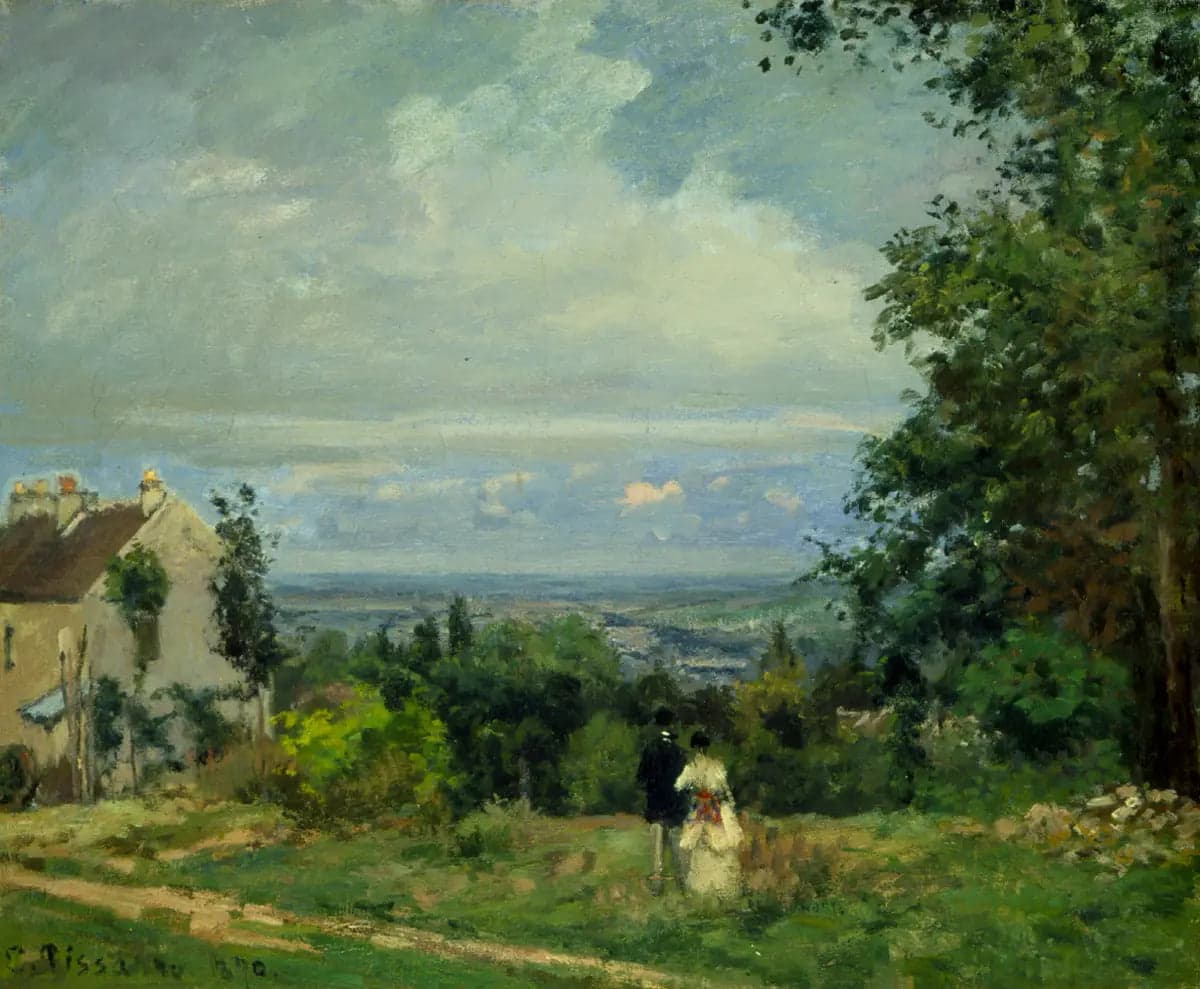
Louveciennes
- Original dimensions
- 55.7 x 45.8 cm
- Museum
- Southampton City Art Gallery
- Year
- 1870
Scene depicted
In this masterpiece, Pissarro offers us a bucolic scene bathed in soft light, depicting the lush fields and flowering trees, where one can almost hear the song of a bird or the murmur of a stream. Every detail of this canvas immerses us in an atmosphere of tranquility, inviting contemplation and wonder in the face of nature laid out before us.
Historical context
Created in 1870, this painting embodies roots in Louveciennes, a charming commune located at the gates of Paris. In a context of artistic upheaval, it expresses the values of the Impressionist movement, which seeks to capture natural light and fleeting visual impressions. Today, the canvas is carefully preserved at the Southampton City Art Gallery , neighboring the British skies, where its dimensions are 55.7 x 45.8 cm, a window opened to a past imbued with poetry.
Place in the artist's career
This painting marks a turning point in the career of Camille Pissarro , fitting into a period of intense stylistic exploration. Positioned between works such as "The Apple Harvest" and "Boulevard Montmartre, Spring," it illustrates his artistic evolution. The bold brushstrokes and the interplay of light and shadows reveal his growing mastery of the Impressionist landscape.
Anecdote
Camille Pissarro said: "Every brushstroke is a note of my floral melody." This painting, conceived on a spring morning, evokes the delicate awakening of nature. The composition of Louveciennes draws from this lived inspiration, where vibrant colors and spring light merge in a gentle harmony, transforming the ordinary into the extraordinary.