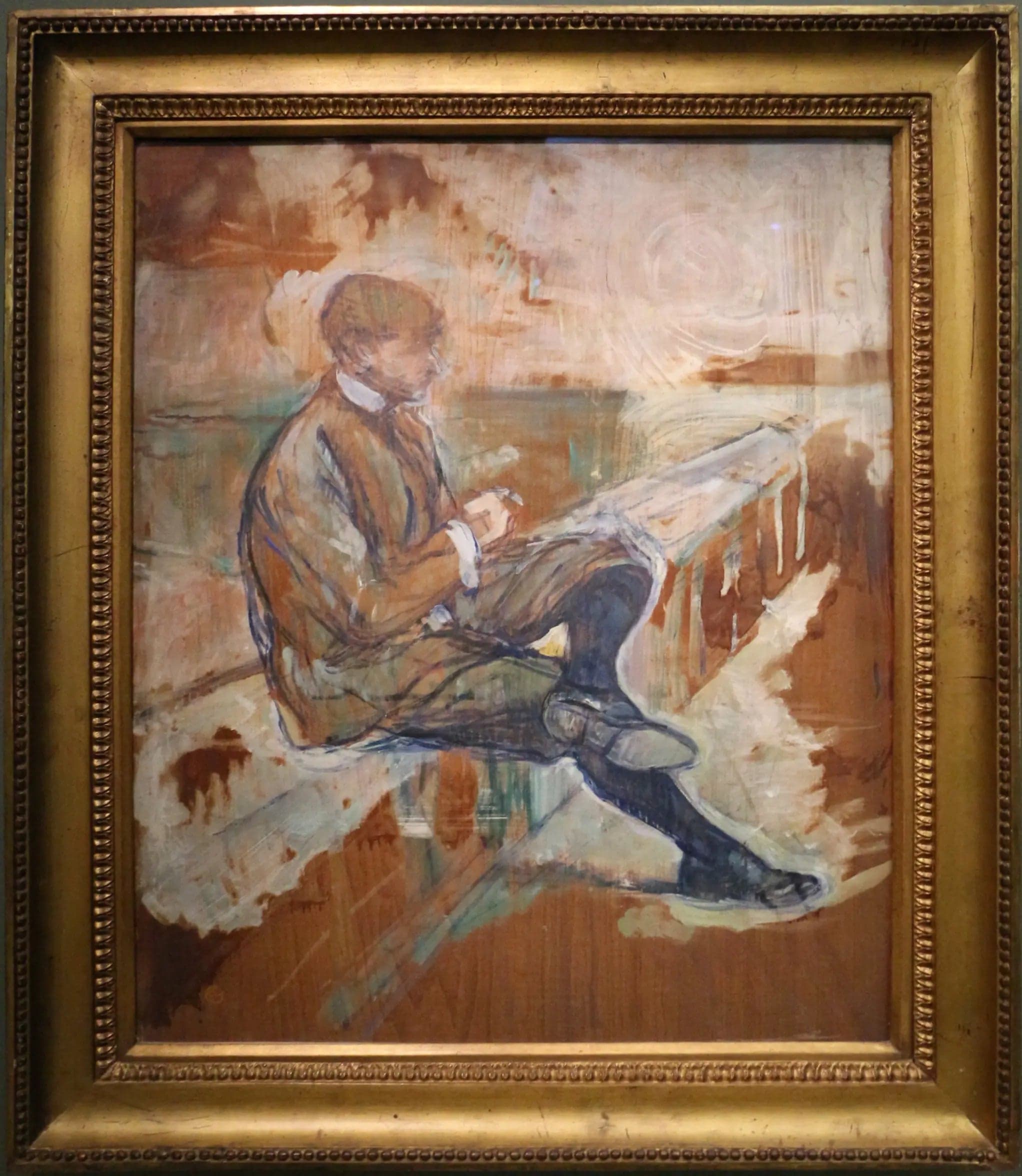
Louis Bouglé - Henri de Toulouse
- Original dimensions
- 51 x 60.1 cm
- Museum
- musée d'Orsay
- Year
- 1898
Scene depicted
In the painting “Louis Bouglé,” the artist depicts a suspended moment, where the characters seem to dance between shadow and light, embodying the effervescence and intrigues of a world dancing under the stars. This vibrant scene reflects a modern aesthetic, where the subject emerges delicately, an indelible imprint of a bygone era.
Historical context
Created in 1898, the painting “Louis Bouglé” is firmly rooted in the bohemian Paris of the late 19th century, a time when the artistic movement of post-impressionism was redefining the aesthetic codes of painting. This masterpiece, capturing the vibrant essence of nightlife, is now exhibited at the musée d'Orsay, an iconic place of French artistic heritage. With dimensions of 51 x 60.1 cm, this canvas is a window into a bygone era.
Place in the artist's career
This painting is situated at a major turning point in Toulouse-Lautrec's career, marking the transition from a promising young talent to a seasoned master of painting . Alongside works such as “At the Moulin Rouge” and “The Canvas of the Folie Bergère,” “Louis Bouglé” illustrates his innovative exploration of forms and colors, testifying to his unique perspective on the world.
Anecdote
Henri de Toulouse-Lautrec , in one of his moments of introspection, reportedly stated: “A painting is an emotion frozen in time.” It was while wandering the streets of Montmartre, amidst cafés and theaters, that he drew inspiration for this memorable work . This painting evokes both the contagious energy and the sweet melancholy of Paris in his time.