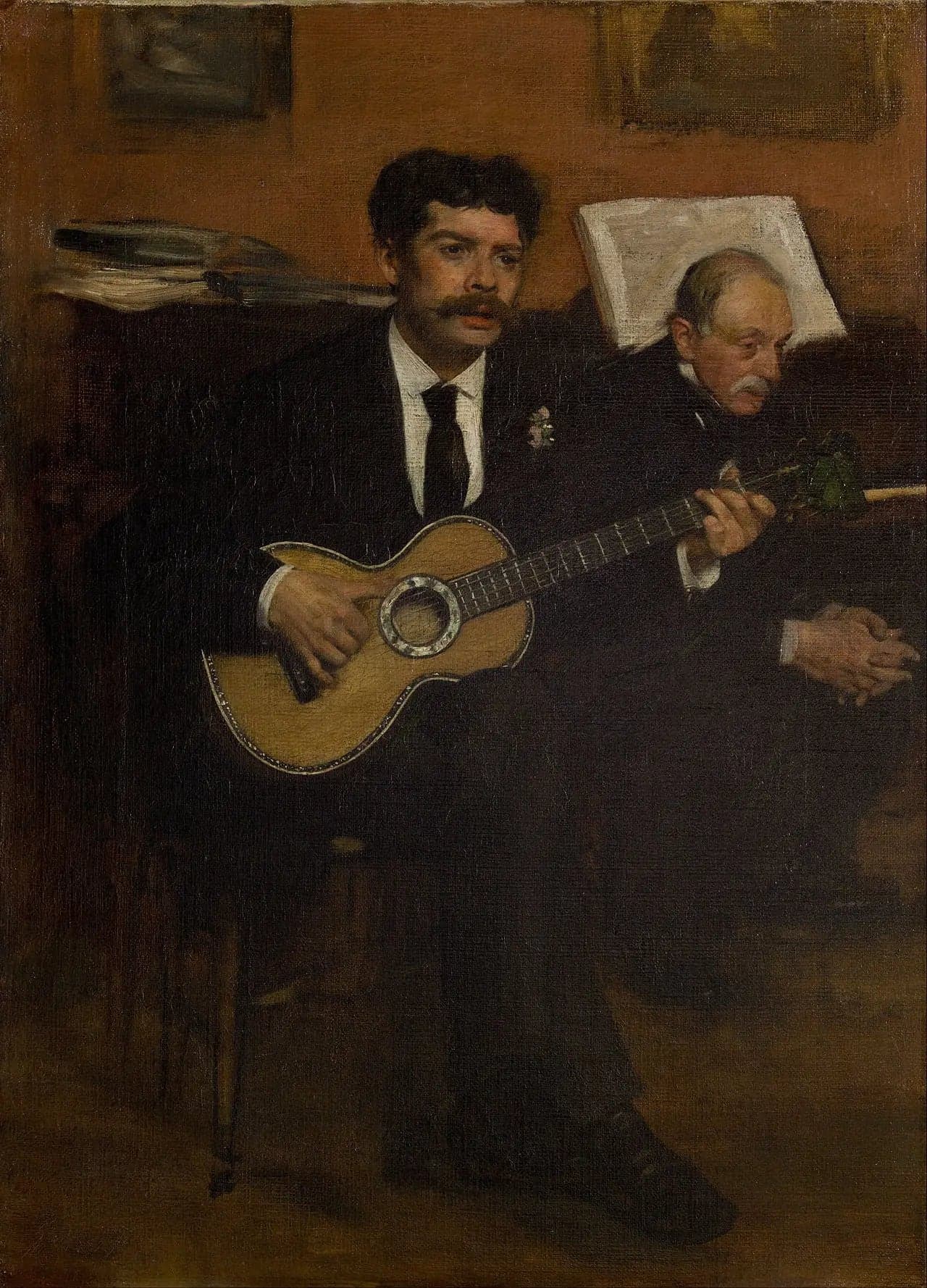
Lorenzo Pagans and Auguste de Gas
- Original dimensions
- 39 x 54 cm
- Museum
- musée d'Orsay
- Year
- 1869
Scene depicted
In this pictorial work , the characters seem to emerge from a living painting, blending into the atmosphere of the time. Degas offers us a glimpse into the artistic scene of Paris, where the soft light illuminates the focused faces of Lorenzo Pagans, listening, and Auguste de Gas, absorbed in creation. Each nuance of this painting creates an atmosphere where the viewer feels transported into the vibrant reality of the moment.
Historical context
This painting , created in 1869 in Paris, is part of the Impressionist movement, a revolutionary artistic current that marked the end of the 19th century. In a cultural effervescence, Edgar Degas immersed himself in Parisian life, where he captured the very essence of modernity through candidly observed scenes. Today, this canvas is exhibited at the prestigious musée d'Orsay , where one can admire its carefully proportioned dimensions.
Place in the artist's career
Positioned at a pivotal time in Degas's career, this canvas represents a stylistic peak. Alongside other works like “Dancers at Rest” and “The Dance Class,” it testifies to his technical and emotional development. This painting perfectly illustrates the evolution of his gaze on movement and light, marking a noisy step towards his artistic maturity.
Anecdote
Edgar Degas once confessed: “Beauty exists in the moment, you just have to know how to catch it.” This emblematic work, born one summer morning in Paris, was inspired by the chance meeting between two figures from the artistic world. In this vibrant place, every color, every shadow seemed to tell a story. Degas's painting captures this moment, a moment of connection between art and life, making this canvas deeply evocative.