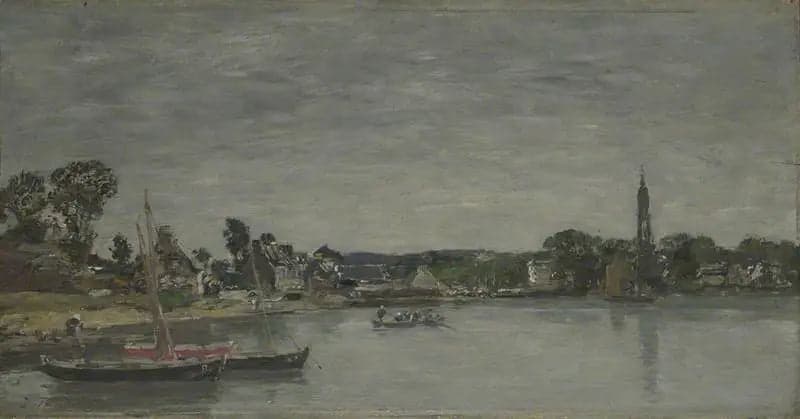
L'Hôpital-Camfrout, Brittany
- Original dimensions
- 39.4 x 20.3 cm
- Museum
- National Gallery
- Year
- 1871
Scene depicted
In this canvas , Boudin immerses us in a peaceful vision of L'Hôpital-Camfrout. The white sails of the boats, delicately anchored on the sparkling water, create a harmonious composition where light plays with the elements. The calm of the scene invites escape, a return to the roots, while nature takes possession of the painting. Every detail, every reflection in the water, tells a silent story, enhanced by the talent of one of the masters of Impressionism .
Historical context
It was in 1871, in the heart of Brittany, that L'Hôpital-Camfrout was born, an iconic painting signed by the master Eugène Boudin . This canvas, rooted in the Impressionist movement, captures the spirit of an era where light and nature become the true muses of artists. Currently exhibited at the National Gallery, this pictorial work testifies to Boudin's unique talent. The dimensions of this canvas reflect a delicacy that attracts the eye and invites contemplation.
Place in the artist's career
L'Hôpital-Camfrout emerges at a pivotal time in Boudin's career, marking a turn towards artistic maturity. While works such as La Plage de Trouville and Le Port de Honfleur already testify to his affinity for the sea and light, this painting stands as a more intimate exploration of the relationship between man and his environment. Through this painting , Boudin foreshadows future explorations of light, thus becoming a pillar for the artists who will follow him.
Anecdote
“True beauty lies in the ephemeral,” Boudin might have said while painting this masterpiece. By settling on the shores of L'Hôpital-Camfrout, he captures a fleeting moment, a morning of awakening where the mist of sunrise gently caresses the horizon. This painting is born from those rare moments when nature dons its finest attire, and each brushstroke is filled with vibrant emotion.