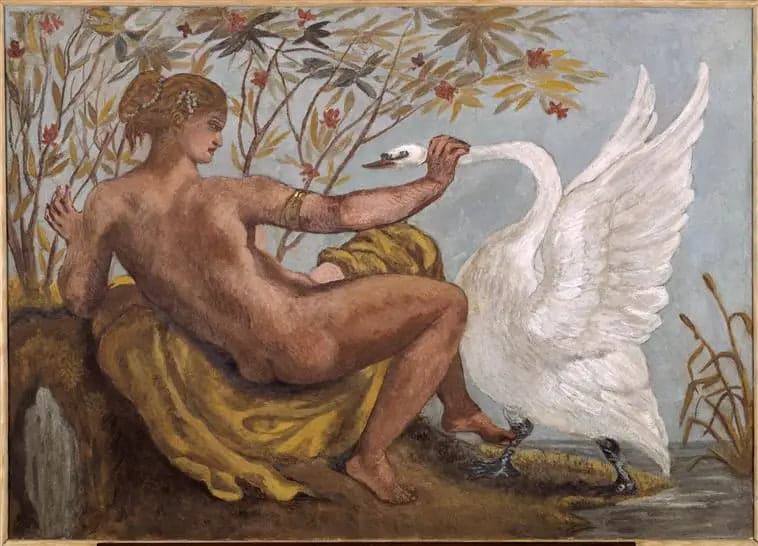
Leda and the Swan
- Original dimensions
- 67 x 88 cm
- Museum
- national museum Eugène-Delacroix
- Year
- 1834
Scene depicted
This painting depicts the famous myth where Leda, the new muse of the god Zeus disguised as a swan, experiences the troubling beauty of this moment. The palpable tension emanating from this composition immerses the viewer in a universe of transformation and mystery, symbolizing the union between humanity and the divine.
Historical context
Created in 1834 at the abbey of Valmont, this painting is emblematic of the romantic movement, characterized by its intense expression and emotional momentum. At that time, Paris was the vibrant heart of an artistic revolution, a true melting pot of innovations. Today, this masterpiece is housed in the national museum Eugène-Delacroix, where it attracts admirers from around the world.
Place in the artist's career
“Leda and the Swan” represents a turning point in Delacroix's career, marking the awakening of his romantic style after his early academic sketches. In parallel, his works such as “ Liberty Leading the People ” and “ The Massacre of Chios ” reveal his growing mastery of color and movement, placing this painting at the peak of his artistic maturity.
Anecdote
“The art of painting is an art of passion,” Delacroix might have said while observing the fiery sky of a spring morning, inspiring this canvas . It is in this moment of fleeting beauty that he found the essence of his painting : a brutal and elegant Emotion, crystallized in the passion between Leda and the swan.