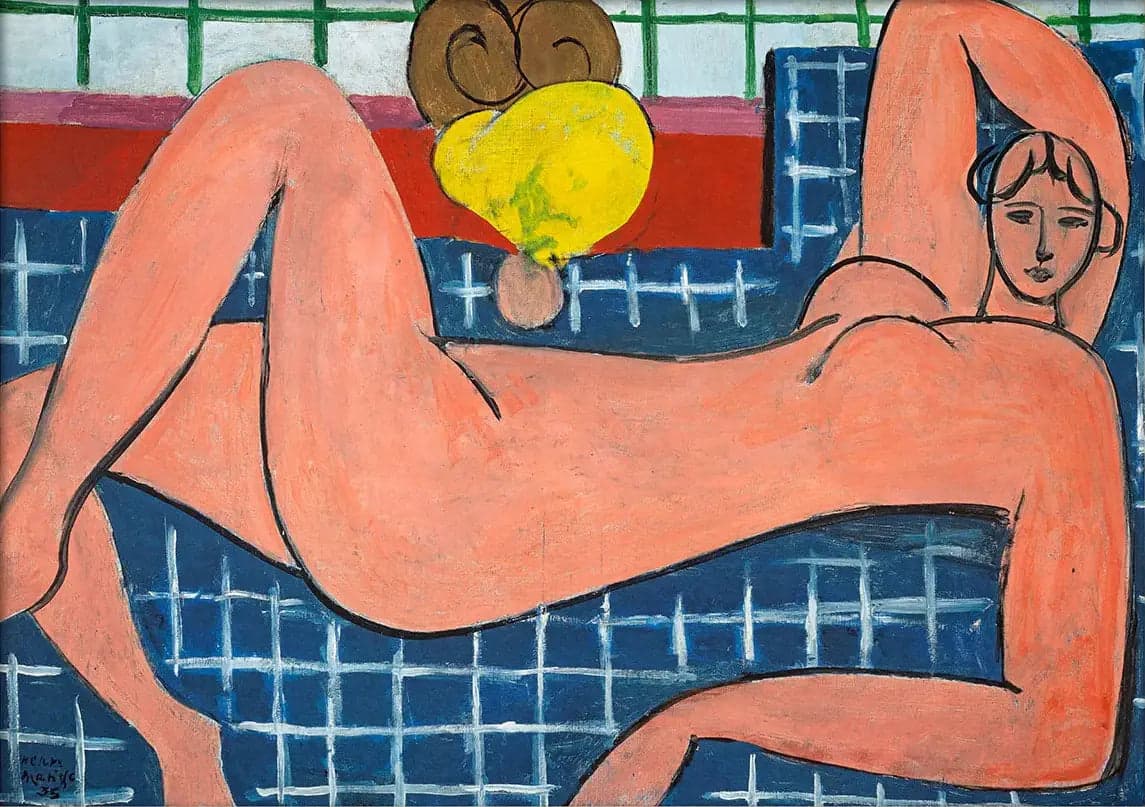
Large Reclining Nude
- Original dimensions
- 93.3 x 66.4 cm
- Museum
- Baltimore Museum of Art
- Year
- 1935
Scene depicted
In this pictorial work , Matisse boldly depicts a woman lying down, her body delicately curved, like a collision between form and color. The composition is a hymn to sensuality and tranquility, capturing an intimacy that makes us feel the softness of a moment suspended in time. The colors, vibrant and harmonious, create an atmosphere that resonates with the depth of the soul.
Historical context
Created in 1935, in the heart of Baltimore, this painting is part of the Fauvist movement, which revolutionizes art through bold colors and unparalleled expressiveness. This painting, now exhibited at the Baltimore Museum of Art , embodies the bold exploration of the nude, a theme dear to Matisse, gracefully navigating between introspection and the exteriority of the time.
Place in the artist's career
This painting , acting as a pivot in Matisse's career, marks a period of stylistic maturity. It comes after other iconic paintings such as “La Joie de Vivre” and “Le Danse,” demonstrating an evolution towards bolder abstraction while preserving the tenderness of the human body.
Anecdote
Henri Matisse once stated: “Color is my first language.” It was through sunny mornings in his studio that this masterpiece took shape, each brushstroke reflecting the brilliance of light filtered through large windows. This painting is an ode to human beauty, a vibrant celebration that evokes dreams of freedom.
Major exhibitions
Matisse. Cahiers d'art, the turning point of the 1930s