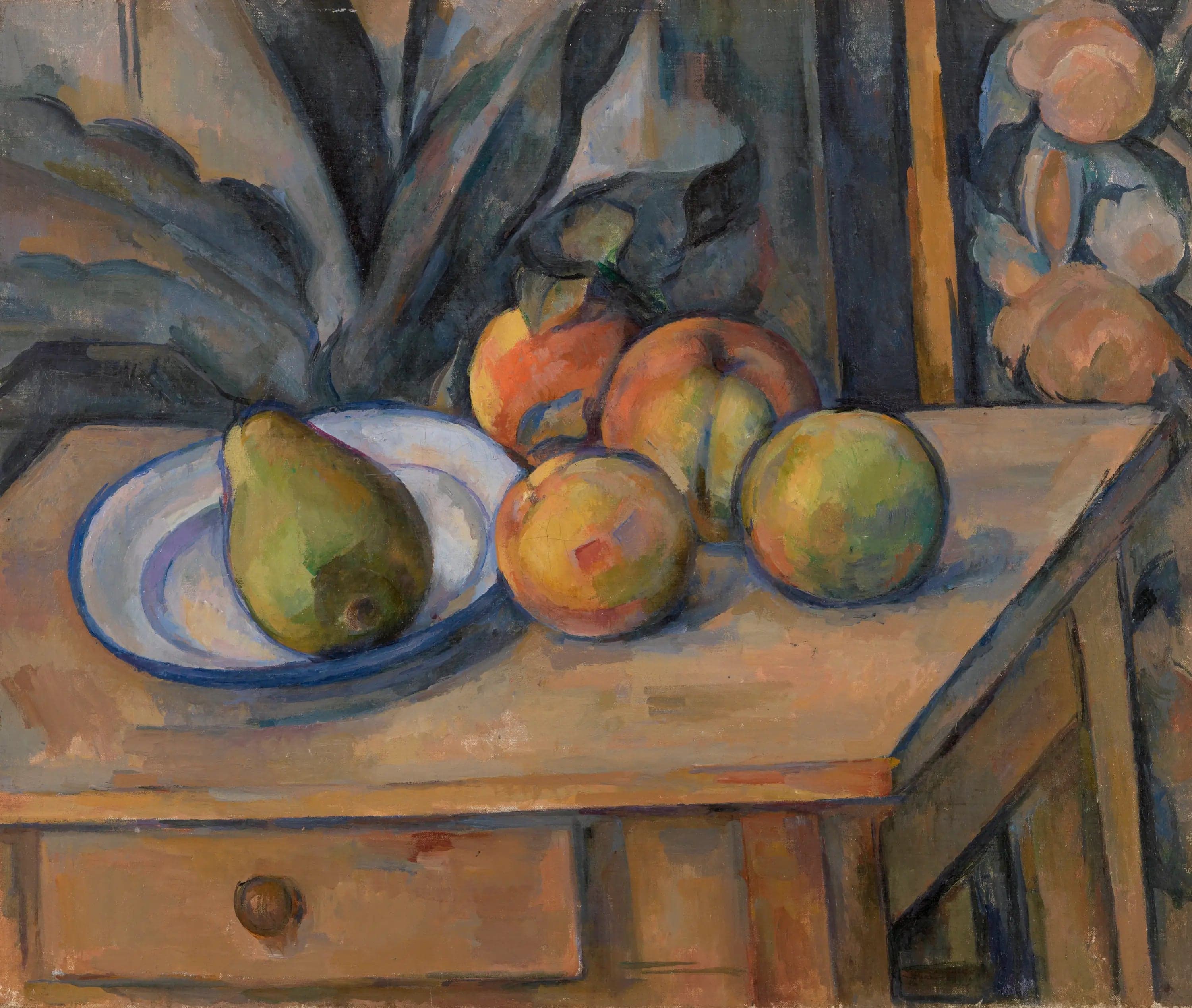
Large Pear
- Original dimensions
- 54.9 x 46 cm
- Museum
- Barnes Foundation
- Year
- 1896
Scene depicted
At the heart of this canvas , a pear placed on a table, illuminated by soft light, seems to breathe a scent of calm and serenity. The composition unfolds, revealing a harmony between curved lines and soft shapes. This painting , with its delicate glow, evokes memories of peaceful moments, caught between nature and daily life. Each brushstroke testifies to Cézanne's fascination with material, while paying homage to the beauty of the simplest object.
Historical context
Created at the end of the 19th century, a time marked by the transition to the modern era, Big Pear finds its roots in Aix-en-Provence, in Provence-Alpes-Côte d'Azur. A leading artist of post-impressionism , Cézanne redefined the contours of pictorial expression of his time. This painting , currently preserved at the Barnes Foundation in Philadelphia, bears witness to a period when artistic avant-gardes blossomed around the world, with an unprecedented quest for color and form.
Place in the artist's career
Big Pear is part of Cézanne's mature period, where the artist explores the relationships between color and form, marking his departure from classical subjects. Alongside it, other works such as The Large Bathers and Still Life with Apples will illustrate his artistic evolution. These paintings testify to his ambition to unify representation and abstraction, inseparable in his pictorial work.
Anecdote
“Nature is my master, and I aspire to capture its essence,” Cézanne might have said while observing this pear, one of the most modest fruits, caught in the delicate light of a sunny morning. This masterpiece is the expression of an intimate encounter with nature, where simplicity meets depth, reconnecting with the original emotion that presided over its creation.