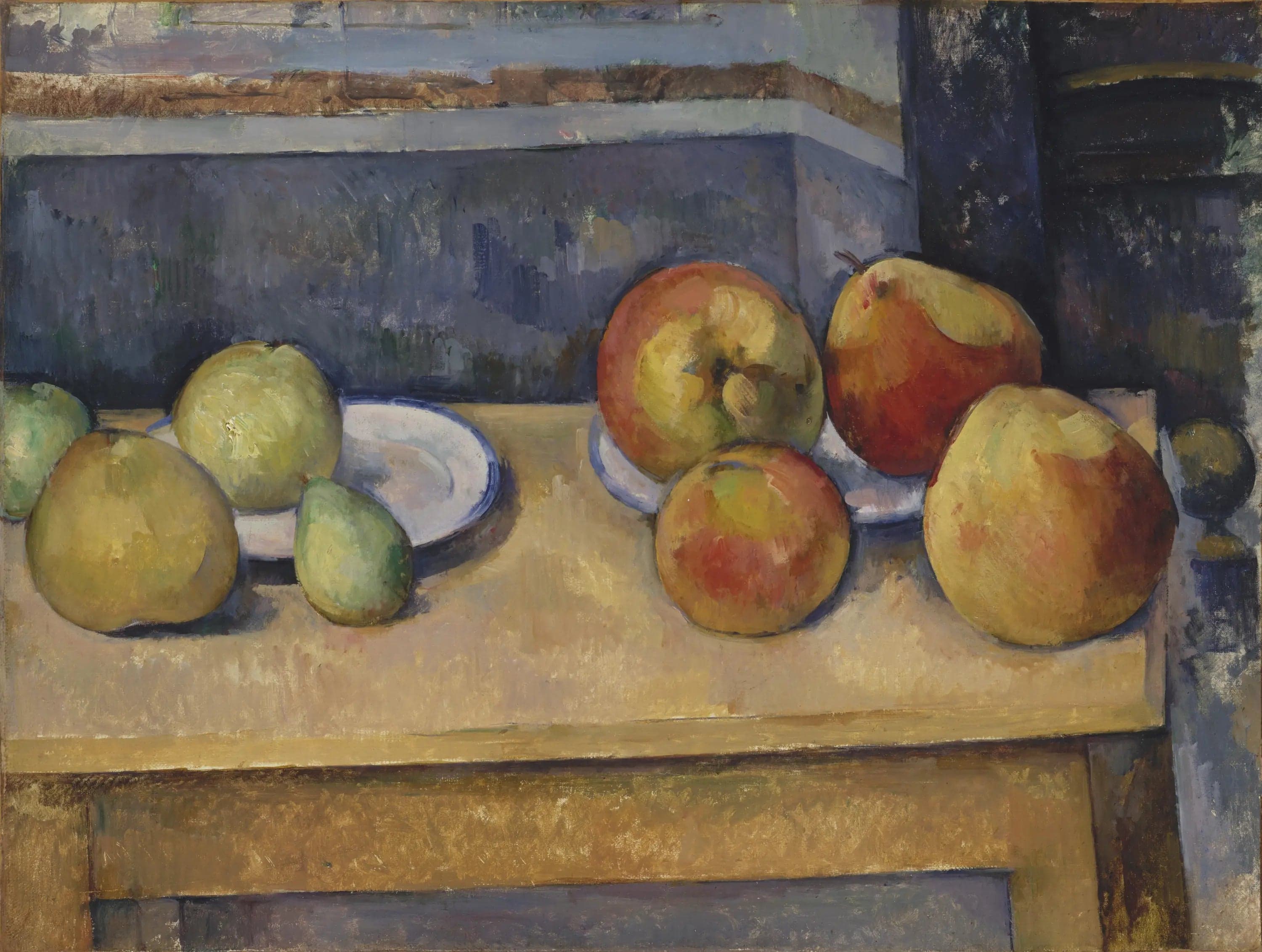
Large Apples
- Original dimensions
- 58.7 x 44.8 cm
- Museum
- Metropolitan Museum of Art
- Year
- 1891
Scene depicted
In "Big Apples," Cézanne depicts a striking still life that goes beyond the simple representation of fruits. Each apple, through its volume and color, tells a story of geometric exploration and color harmonization. This masterpiece is a tribute to the beauty of natural elements, materialized by the brilliance of surfaces and the palpable dialogue between the objects in the composition.
Historical context
Created in 1891, the painting "Big Apples" stands at the crossroads of modern art, rooted in the Impressionist movement that highlights nature and light. This canvas , emblematic of master Cézanne, is today preserved at the Metropolitan Museum of Art in New York, thus celebrating the artistic heritage of the city. This painting, measuring 58.7 x 44.8 cm, encapsulates the essence of an era when art began to explore entirely new forms and perspectives.
Place in the artist's career
This canvas , a beacon in Cézanne's career, marks his period of artistic maturity, illustrating a style in full evolution. At this time, he moves away from traditional forms, as evidenced by his other major works, "The Card Players" and "The Montagne Sainte-Victoire." "Big Apples" stands as a milestone, connecting his concerns for color and structure.
Anecdote
"To paint an apple, it takes a whole world," Cézanne might have said, amazed by the depth of such a simple fruit. Inspired by the orchards of his childhood in Provence, he would have seen in each painting an opportunity to immortalize the fleeting beauty of nature. This moment of creation reveals the evocative power of painting as a reflection of the soul.