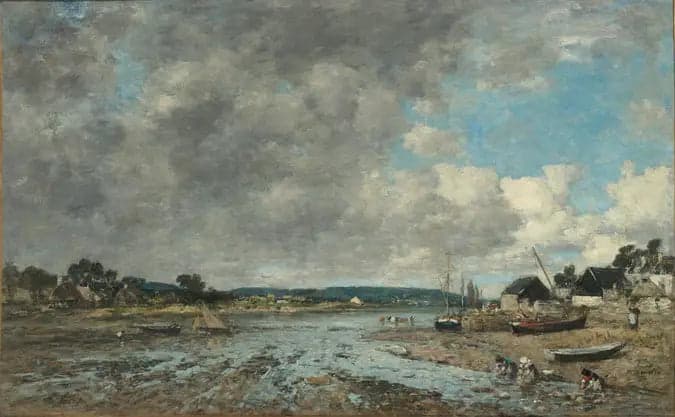
Landscape with Washerwomen
- Original dimensions
- 58 x 37 cm
- Museum
- Caen Museum of Fine Arts
- Year
- 1873
Scene depicted
In Landscape with Washerwomen , Boudin offers us a bucolic scene where women, dressed in aprons, stand by a river, busy washing clothes. The composition is delicately structured around the movements of nature, paying homage to the beauty of the everyday. One can almost hear the murmur of the water and the rustling of the clothes drying in the wind. This canvas goes beyond a mere snapshot; it tells a narrative imbued with serenity, efficiency, and humanity.
Historical context
Created in 1873, the painting titled Landscape with Washerwomen reflects the Impressionist era, an artistic movement that flourished in France. This canvas is currently housed in the Caen Museum of Fine Arts, a city rich in history and artistic culture. In this work , the artist captures fleeting moments of everyday life, revealing a unique sensitivity to light and nature.
Place in the artist's career
Landscape with Washerwomen represents a major milestone in Boudin's career, marking the beginning of his recognition within the Impressionist movement. Compared to The Beach at Trouville and The Boats of Honfleur , this painting illustrates an evolution in his style: a shift from strict realism to a more free and luminous interpretation of nature. The viewer becomes a witness to a period of artistic maturation that begins to assert itself and makes him a precursor of the Impressionist masters.
Anecdote
“Light is my muse, it dances in every reflection” could have declared Eugène Boudin during the creation of this masterpiece . It was by the sea, on a cool morning, that the artist, inspired by the gentle lapping of the waves and the laughter of the washerwomen, sought to immortalize this vibrant scene of life and color. This moment of escape is both simple and universal, an invitation to dive into the universe of his painting .