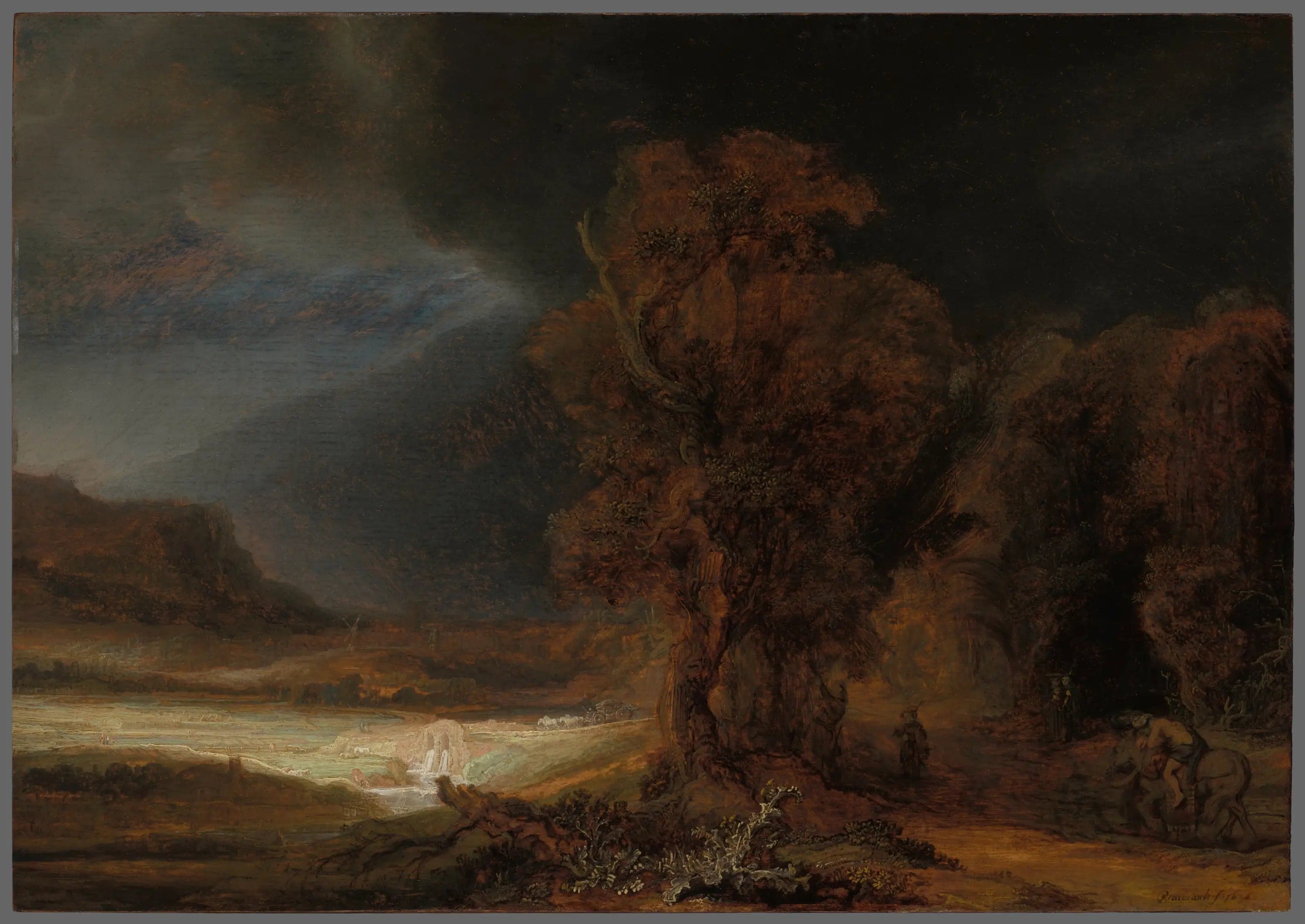
Landscape with the Good Samaritan
- Original dimensions
- 65.5 x 46.5 cm
- Movement
- Dutch Golden Age
- Museum
- National Museum of Krakow
- Year
- 1638
Scene depicted
In this painting, Rembrandt captures a moment of human compassion, where the Good Samaritan reaches out to an injured man. The atmosphere is imbued with softness, where each element of the painting interacts with the other: the gentle light caresses the figures while illuminating the lush landscape, while the expression of care on the faces transcends time and space.
Historical context
Created in 1638, during the Dutch Golden Age of painting, Landscape with the Good Samaritan is the result of a period rich in artistic innovations in Amsterdam. This painting, currently displayed at the National Museum of Krakow, perfectly illustrates the rise of realism and palpable emotion within the pictorial works of this era. With its dimensions of 65.5 x 46.5 cm, this painting is part of a movement that marked the history of art with its narrative depth.
Place in the artist's career
Landscape with the Good Samaritan represents a stage of maturity in the career of Rembrandt . With this masterpiece, he asserts himself through an increased mastery of light and palpable emotion, skills that can also be found in other paintings such as The Night Watch or The Elements of Vanity , reflecting a constant evolution towards greater human depth.
Anecdote
Rembrandt , when painting, often said: “A canvas is never just a canvas, but an echo of my soul.” Imagine him, immersed in his thoughts, at the turn of a quiet alley in Amsterdam, seeking inspiration in the morning light. It is this moment that we find in the evocative power of Landscape with the Good Samaritan , a transcendent work that continues to touch the heart.