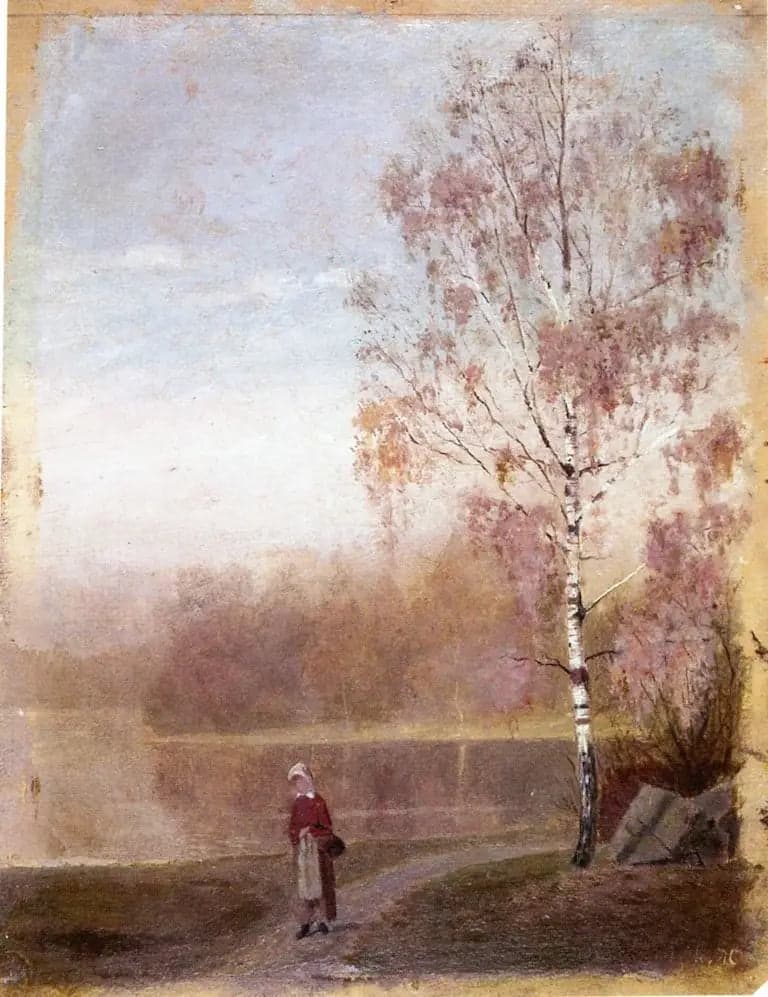
Landscape with a Woman Walking Along a Lake
- Original dimensions
- 14 x 19.5 cm
- Museum
- Not specified
- Year
- 1880
Scene depicted
In this masterpiece, a silhouetted woman stands at the edge of a peaceful lake, her presence highlighting the fragile harmony between the human and the natural world. Munch skillfully plays with the elements of composition: the shimmering waters reflect the sky, while the movement of the woman evokes introspection and a spiritual connection with the surrounding environment.
Historical context
Created in 1880, this painting unfolds in a rich historical context, where Edvard Munch , a major figure of symbolism and a precursor of expressionism , captures the nuances of nature in Oslo, Norway. At the heart of a transformative era, the canvas evokes a contemplative solitude imbued with emotion. Although the work is not currently exhibited in a specific museum, its essence lives on through every brushstroke in the modest dimensions of 14 x 19.5 cm.
Place in the artist's career
This canvas represents a significant milestone in Munch's career, marking the transition between his early works influenced by romanticism and his evolution towards darker and more introspective themes. Compared to other achievements like “The Scream” and “The Madonna,” this masterpiece testifies to his ongoing exploration of human emotions through vibrant landscapes.
Anecdote
“Inspiration is often found in the silence of a walk,” Munch might have said, recalling that particular moment when a woman walked along a lake, absorbing the nuances of the morning light. This canvas is not just a simple landscape, but a fragment of life, an echo of intimacy between man and nature, created in a moment of deep feeling.