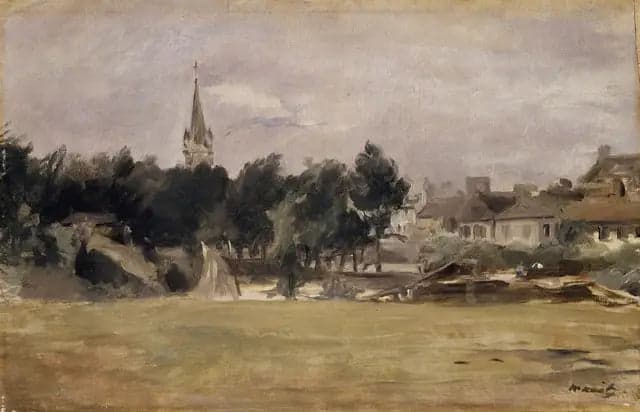
Landscape with a Village Church
- Original dimensions
- 44 x 30 cm
- Museum
- Ashmolean Museum
- Year
- 1870
Scene depicted
This painting evokes a palpable tranquility, where the softness of light mingles with the silhouette of a village church. The soft hues and harmonious composition offer a sense of peace, capturing the essence of a simple and serene rural life. Every detail tells a story, transforming into a living visual poem, rich with a soothing atmosphere.
Historical context
Created in 1870, this canvas dazzles, painted by one of the masters of impressionism , Édouard Manet , will please European art lovers. The impressionist movement, vibrant with innovation, particularly shines at this time. The painting , currently housed in the Ashmolean Museum, offers a window into timeless beauty, inviting the viewer to lose themselves in the splendor of a rustic village landscape.
Place in the artist's career
As a major representative of impressionism , this painting represents a key moment in Manet's artistic evolution. Just before this work, "Luncheon on the Grass" heralds the beginning of a bold impressionism , while shortly after, pieces like "The Masked Ball" will mark the maturity of his style. Landscape with a Village Church is a perfect symbiosis of his technique and emotion, illustrating his exquisite artistic journey.
Anecdote
Manet once said: "Nature is my best master," highlighting the importance of this inspiration. Imagine a spring morning, the first rays of sunlight filtering through the trees, illuminating a village face. It is in this setting that the masterpiece was born, a tactile emotion etched in every brushstroke.