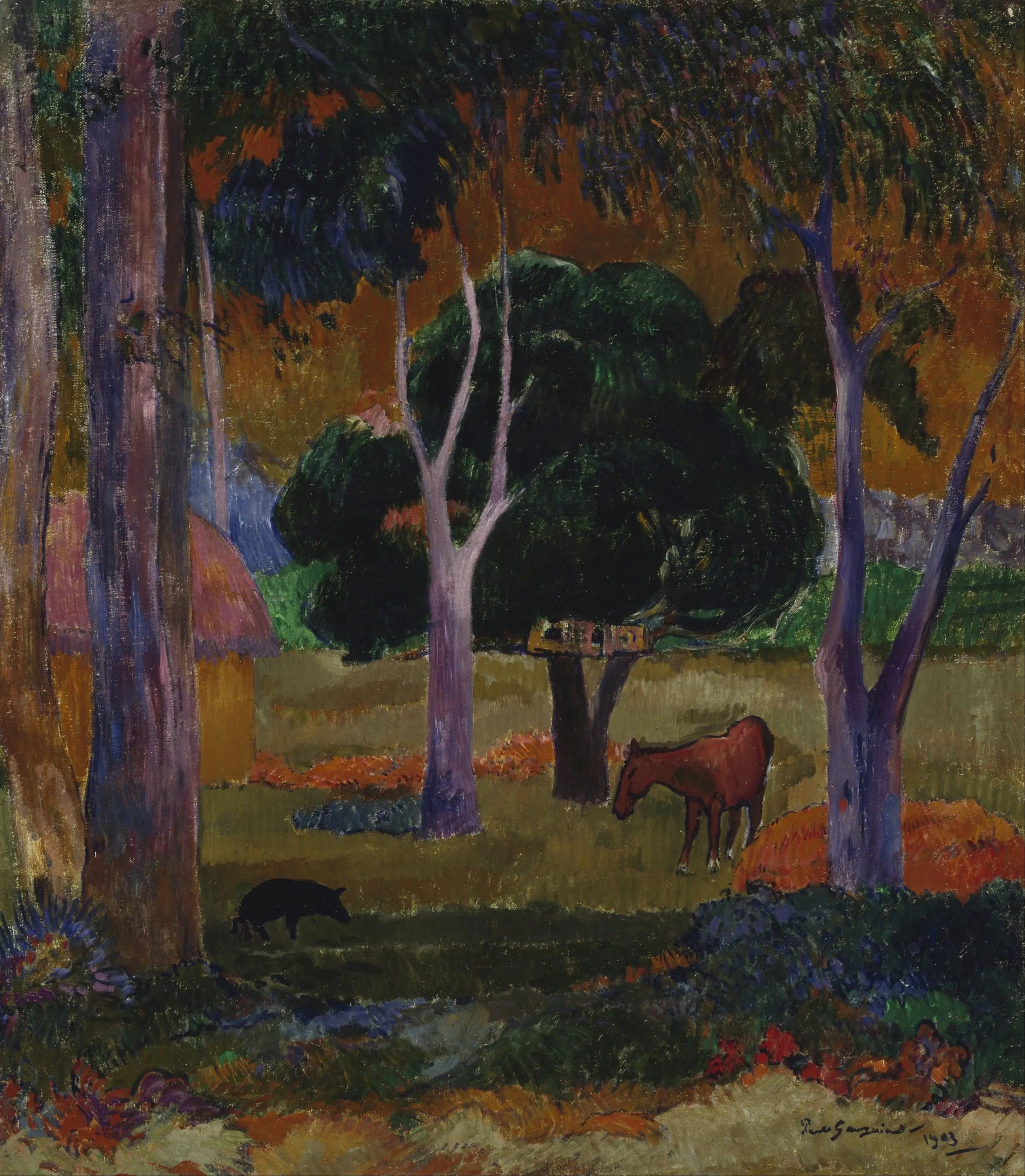
Landscape with a Pig and a Horse
- Original dimensions
- 67 x 75 cm
- Museum
- Ateneum Art Museum
- Year
- 1903
Scene depicted
In this pictorial work, Gauguin transports us to the heart of a simple yet beautiful rural landscape, where a pig grazes peacefully while a horse stands nearby. The rounded shapes and vibrant colors evoke the tranquility of the Breton countryside and the fleeting moments of daily life. Each element seems to tell a story, an invitation to contemplate the beauty of nature and the harmonious coexistence of living beings in a serene environment.
Historical context
Created in 1903, this painting is set against the rich and vibrant backdrop of the late 19th century, a time of profound artistic upheaval. Paul Gauguin , a leading figure of the Post Impressionists , settled in Pont-Aven, a small Breton town, where he sought an authentic connection with rural life. This iconic canvas , currently displayed at the Ateneum Art Museum in Finland, illustrates this quest for simplicity and truth. Its dimensions of 67 x 75 cm surround a peaceful atmosphere, imbued with nature and rurality.
Place in the artist's career
Landscape with a Pig and a Horse stands as a pivotal work in Gauguin's career, marking a shift towards a more symbolic expression of nature. At the dawn of the synthetic period of his work, this painting echoes other canvases such as “The Vision after the Sermon” and “The Card Players,” revealing an evolution towards bolder and emotionally charged compositions.
Anecdote
“When I paint, I isolate my vision of the world. Reality is a dream, the dream is my reality.” This quote from Gauguin resonates strongly through the creative process that gave birth to this masterpiece . A spring morning in Pont-Aven, when the first rays of sunlight sparkle on the dew on the grass, inspired every brushstroke of this canvas , capturing the wonder and serenity of the scene.