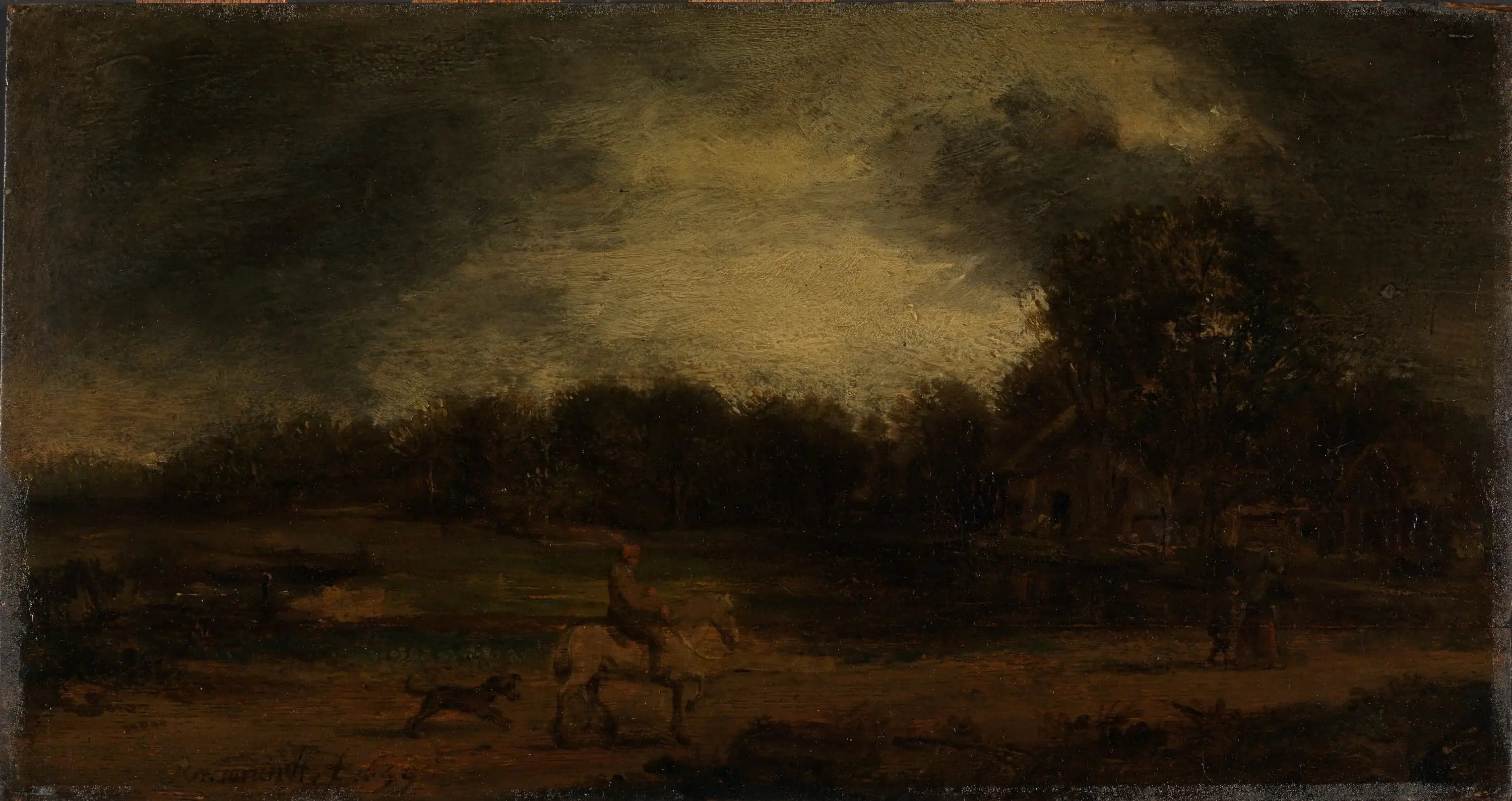
Landscape with a Horseman
- Original dimensions
- 36.5 x 19.5 cm
- Museum
- National Museum
- Year
- 1639
Scene depicted
This canvas depicts a solitary peasant, a resigned silhouette, quietly riding in a vast and serene landscape, bordered by bright trees and a soothing sky. The composition evokes an intimate harmony between man and nature, symbolizing a journey both inward and outward. Rembrandt , with his undeniable talent, transports us into this tranquil scene, filled with promises and daydreams.
Historical context
Created in 1639 in Amsterdam, this painting is emblematic at the intersection of baroque and realism . Rembrandt , perfecting his art in the city of canals, managed to capture the essence of a Europe in full cultural and artistic effervescence. This canvas is now located in the National Museum, where its history and magnificence continue to fascinate visitors.
Place in the artist's career
This canvas , considered one of the major works of Rembrandt , showcases a turning point in his career. At a time when he is beginning his ascent to fame, this painting foreshadows the emotional modulations present in his later works, such as the “School of Athens” and the famous “Return of the Prodigal Son.” A reflection of evolution that does not escape the discerning eye.
Anecdote
“Art is a reflection of the soul, an echo of the nature that surrounds us,” said Rembrandt . Inspired one spring morning while wandering in the countryside, he encountered a horseman illuminated by the first rays of the sun. It is this fleeting moment that breathed life into the painting of this masterpiece , now etched in time.