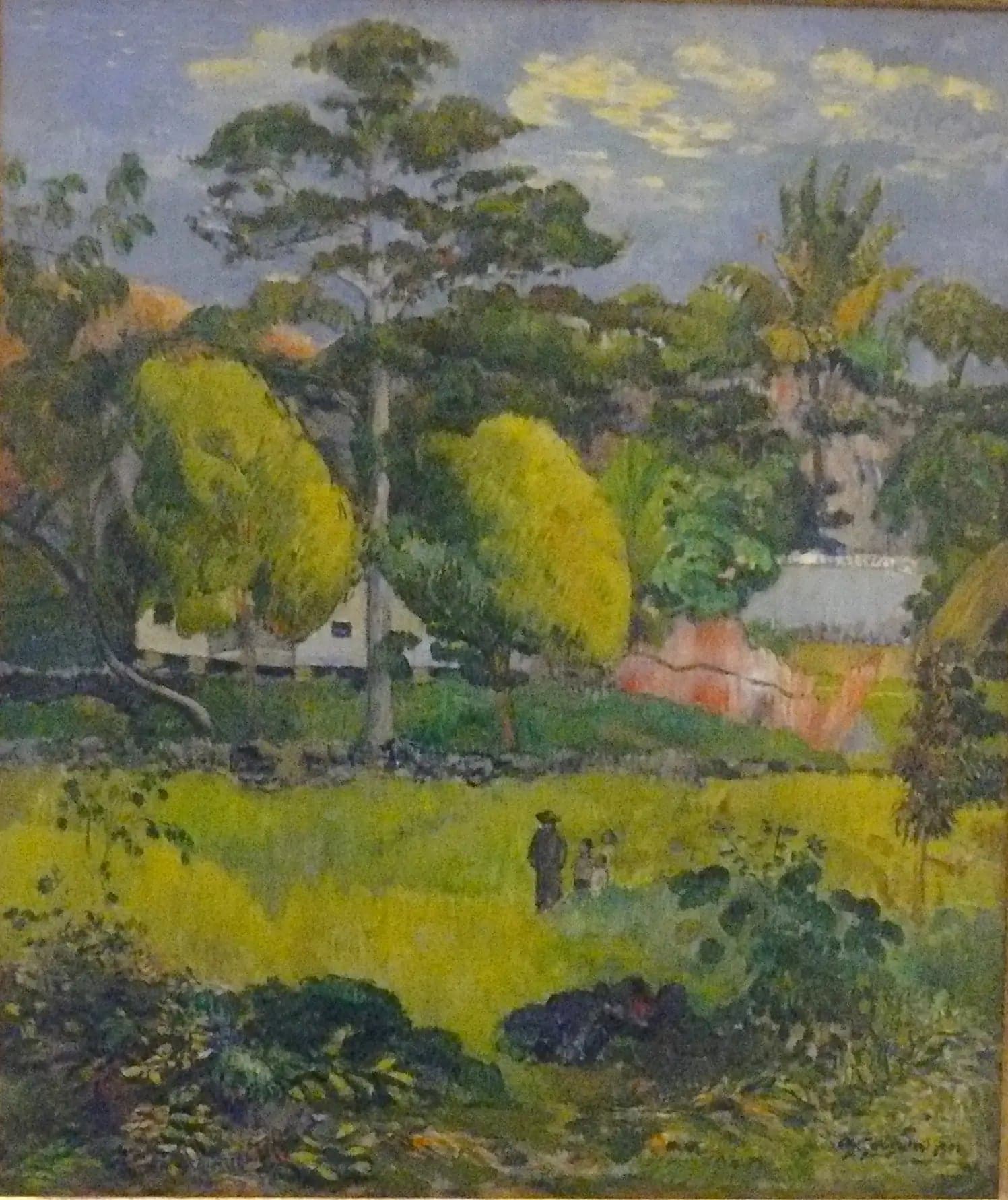
Landscape
- Original dimensions
- 65 x 76 cm
- Museum
- Orangerie Museum
- Year
- 1901
Scene depicted
In this pictorial work, Gauguin invites us to dive into a landscape where the shimmering hues of nature blend into a harmonious composition. The shapes merge into a cerulean blue of the sky, framing the lush vegetation. It is an invitation to admire the landscape as a space rich in emotions, a beating heart of the earth where beauty flourishes.
Historical context
In the year 1901, in the heart of the beautiful city of Paris, Paul Gauguin , an emblematic figure of the post-impressionist movement, brought his painting Landscape to life. This masterpiece, exhibited at the Orangerie Museum , is set in a time marked by an artistic quest for emotions and colors. This painting, measuring 65 x 76 cm, perfectly illustrates the transition from a more traditional view to a bolder vision of nature.
Place in the artist's career
Landscape represents a turning point in Gauguin's career. After beginnings marked by the impressionist sentiment in The Sea at La Rochelle and the experimentation with bright colors in The Women of Tahiti , this canvas bears witness to an artistic maturation through its stylized forms and poetic atmosphere, which foreshadow the artist's later explorations in Polynesia.
Anecdote
“Nature is an open book where each color tells a story,” Gauguin might have said one bright morning, sitting in a Parisian park, contemplating the play of light on the foliage. It is this light, this sensory feeling, that shines through in the vibrant painting of Landscape , like a visual melody that awakens buried memories and emotions.