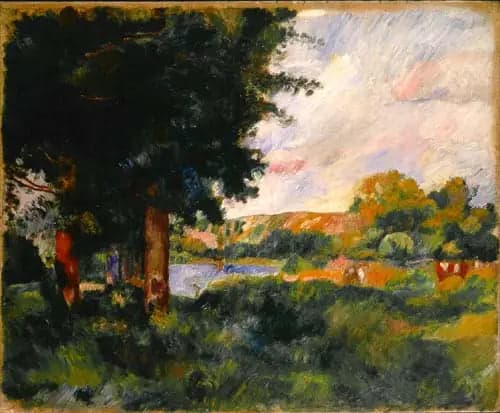
Landscape of Île-de-France - Pierre
- Original dimensions
- 65 x 54 cm
- Museum
- Botero museum
- Year
- 1883
Scene depicted
This painting offers a panoramic view of the tranquility of Île-de-France, capturing the very essence of the French countryside with its lush fields and tranquil rivers. Through a vibrant palette, Renoir composes a painting where every detail seems to vibrate with its own life. The diffuse and warm light illuminates every element, paying homage to the natural splendor of its environment.
Historical context
Created in 1883, Landscape of Île-de-France immerses the viewer in the bucolic charms of this magnificent French region, emblematic of the Impressionist movement. At that time, Renoir explored changing light and landscapes, paying tribute to the natural beauty that surrounded him. Currently, this painting is preserved in the famous Botero museum, where it continues to dazzle visitors with its composition and atmosphere.
Place in the artist's career
Landscape of Île-de-France fits into a key period of Renoir's career, symbolizing his transition to a brighter and lighter abstraction. When compared to The Bathers and The Girls in the Garden , one observes the evolution of his technique, moving from a more pronounced realism to more delicate and spontaneous impressions, conducive to a feeling of freedom.
Anecdote
“Nature is my greatest source of inspiration, it dances before my eyes, and I only capture it,” Renoir is said to have declared, reminiscing about his creative process. It was during a gentle spring morning, cradled by the songs of birds and soft breezes, that he found inspiration to create this pictorial work . In this sense, Landscape of Île-de-France resonates with all the vibrancy of this moment suspended in time.