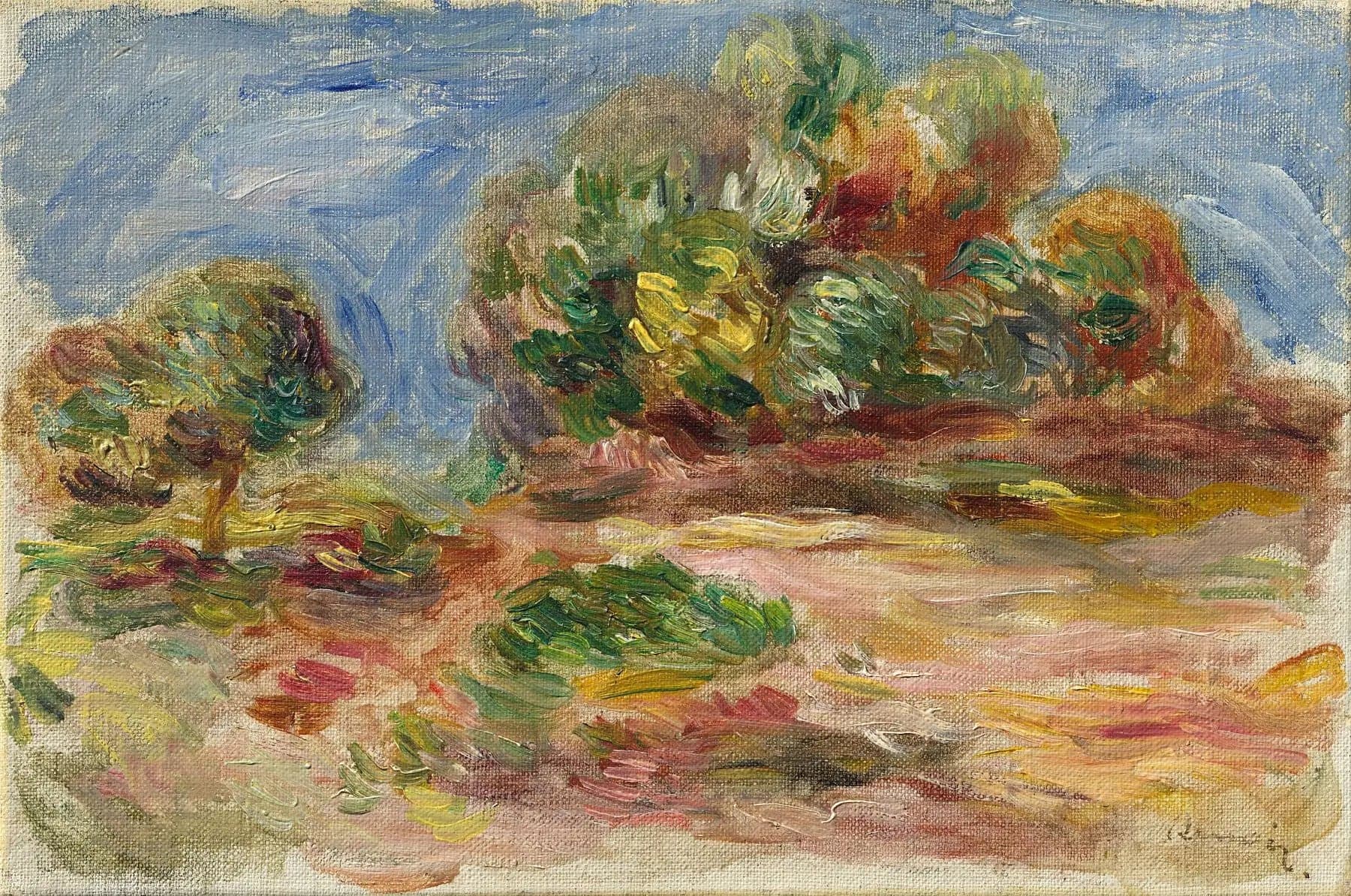
Landscape of Cagnes - Pierre
- Original dimensions
- 32.5 x 22 cm
- Museum
- Barberini museum
- Year
- 1900
Scene depicted
The painting Landscape of Cagnes immerses us in the heart of a bucolic scene bathed in light. Verdant hills embrace the horizon, while shades of blue and green blend harmoniously to create a soothing atmosphere. Renoir's spirit transports us to this natural setting where time seems suspended, evoking the tranquility and beauty of nature.
Historical context
Created in 1900, the painting Landscape of Cagnes finds its origin in the coastal town of Cagnes-sur-Mer, located on the splendid French Riviera. Belonging to the Impressionist movement, this exceptional canvas illustrates the painter's quest to capture the light and emotions of nature. Today, the painting resides at the Barberini museum , where it continues to enchant visitors with its refined dimensions of 32.5 x 22 cm.
Place in the artist's career
Landscape of Cagnes is part of a significant period in Renoir's career, where he explores new techniques of representation and light. This painting is situated between his masterpiece The Bathers (1887) and Ball at the Moulin de la Galette (1876), thus revealing a continuous evolution both stylistically and emotionally in his work.
Anecdote
Auguste Renoir often mentioned that beauty lies in the simplest things in life. One spring morning, he saw the sun-drenched hills and was transported by the vibrant hues emanating from this landscape. It is this clarity, this delicate scent of flowers mixed with the salty air that permeates his masterpiece Landscape of Cagnes .