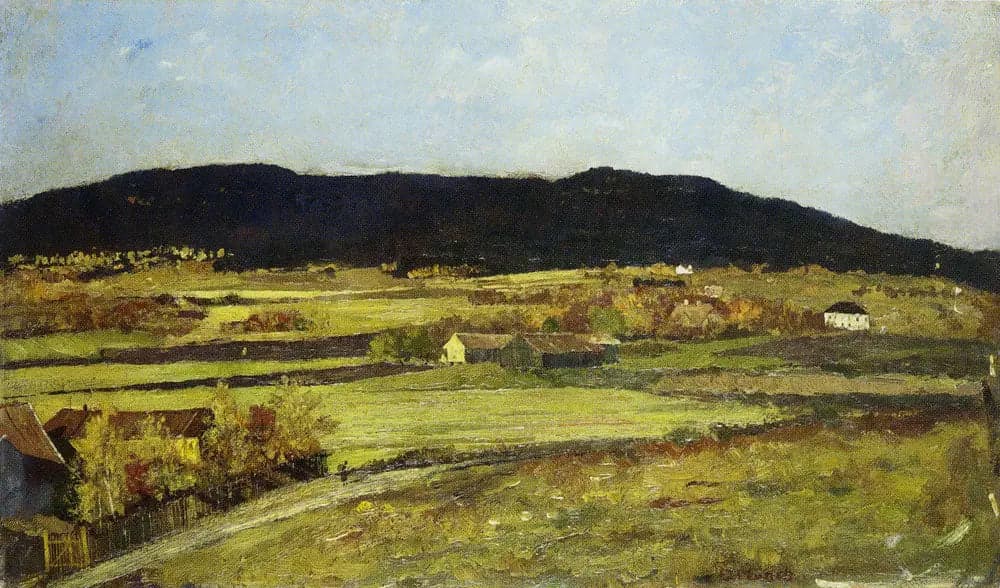
Landscape of Asker
- Original dimensions
- 62 x 37 cm
- Museum
- Not specified
- Year
- 1883
Scene depicted
In the painting “Landscape of Asker,” Munch depicts a natural setting of striking depth. The canvas evokes a thrilling serenity, where green and blue hues dance in the daylight. The composition transports us to the heart of a benevolent nature, full of vitality, revealing a new detail and a new emotion with each glance. The tall trees stand proudly, silent witnesses of the moment frozen in time.
Historical context
Created in 1883, this painting is part of the expressionist movement, a period marked by a quest for intangible emotions and a new visual approach to the world. Edvard Munch , whose hometown is Oslo, transforms a simple landscape into an invitation to contemplation. Although the painting is not preserved in a specific museum, it remains an emblematic piece of the artist's journey.
Place in the artist's career
Landscape of Asker represents a fundamental step in the career of Edvard Munch . Revealing his early talent, this painting sits between his promising beginnings and his evolution towards iconic works such as “The Scream” and “Madonna.” It marks a technical and emotional transition that propels him to his artistic peak.
Anecdote
“Nature does not let itself be forgotten, it whispers to our souls.” On a spring morning, young Munch walks through the hills around Asker. It is there that he discovers the wild and lucid beauty of this painting , capturing it with passion, bringing to life a pictorial work where each brushstroke tells a story.