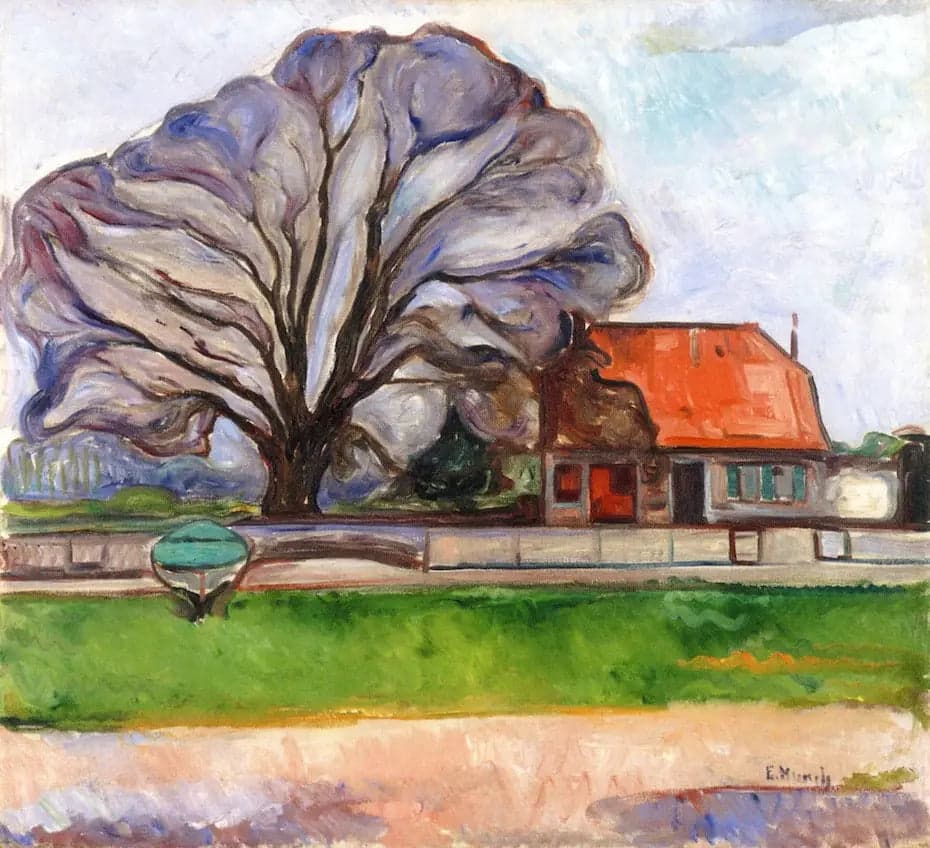
Landscape near Travemünde
- Original dimensions
- 100 x 91.5 cm
- Museum
- Munch Museum
- Year
- 1903
Scene depicted
In this pictorial work, Edvard Munch evokes a bucolic marine landscape, bathed in golden light and a sky that fades into shades of azure. The waves dance delicately to the rhythm of the wind, and the trees, vibrant with life, stand as guardians of this authentic nature. Each brushstroke marries with the effervescence of the places, transporting the viewer to the heart of an idyllic serenity.
Historical context
Created in 1903, the painting titled Landscape near Travemünde finds its origin on the Baltic coast in Germany, more precisely in Travemünde. This canvas is emblematic of the Symbolist movement, an artistic movement where Edvard Munch excels, revealing his inner voice and emotions in his creations. Today, this painting holds a special place in the Munch Museum, a true sanctuary for art and creativity, with its robust dimensions of 100 x 91.5 cm captivating anyone who lingers there.
Place in the artist's career
Landscape near Travemünde positions itself in a crucial period of Edvard Munch 's career. It is a work of maturity, where technicality and emotional momentum converge, akin to his other paintings like The Scream and The Madonna . This painting stands out for its bold approach to natural light and its ability to evoke hidden feelings, thus showcasing the sublime evolution of his art.
Anecdote
Edvard Munch once stated: "Painting is rather a form of writing, it is closer to poetry than to drawing." This vision resonates strongly during the creation of his masterpiece Landscape near Travemünde , where one sunny morning, overwhelmed by the sweetness of spring's ardor, he allowed himself to be inspired by the surrounding beauty. It is in this old-fashioned atmosphere, where the song of birds mingles with the gentle breeze, that this masterful painting is born.