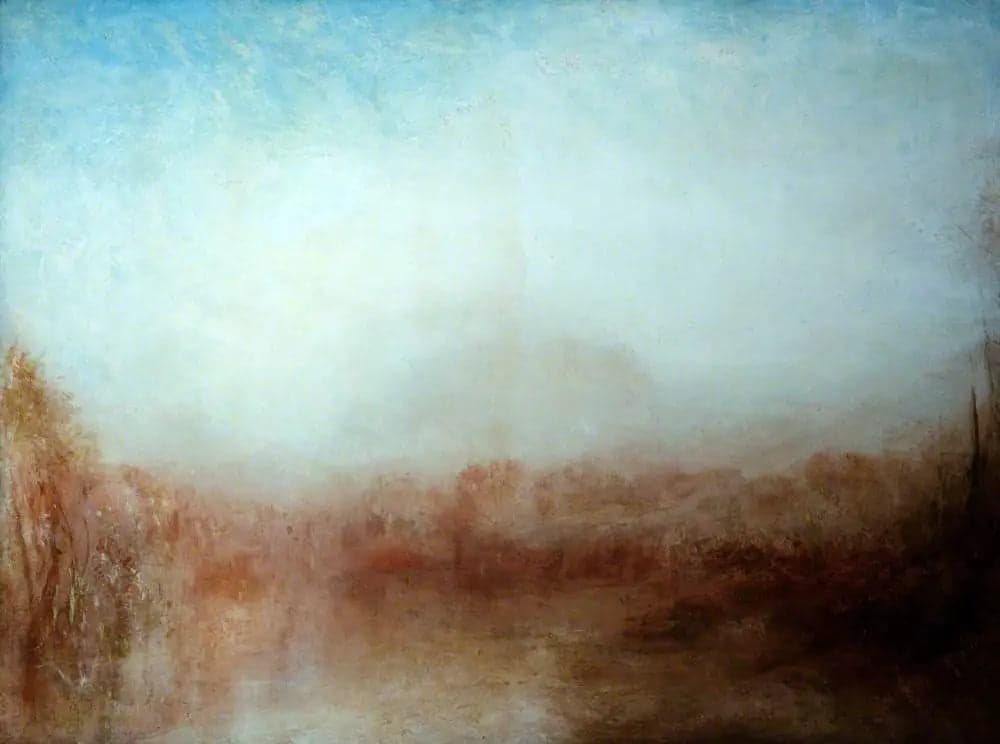
Landscape
- Original dimensions
- 90.7 x 63.3 cm
- Museum
- Hermitage Museum
- Year
- 1850
Scene depicted
The painting “Landscape - J. M. W. Turner” captures a fleeting moment in time, where the skies ablaze with golden light merge with rolling hills and shimmering rivers. This painting is a celebration of natural elements, where the sky seems to sing while the earth echoes in response. The layers of paint testify to the harmony between the earthly and the celestial, offering a resonance that touches the souls of observers.
Historical context
Created in 1850, this painting is a major work of the romantic movement, a movement that found its voice in the intensities of nature and the passion of emotion. Its creator, Turner, was able to capture the very essence of his time, an era when industrialization was beginning to transform the British landscape. Today preserved at the Hermitage Museum , this masterpiece has traversed the centuries, testifying to the grandeur of its time and the talents of its artist.
Place in the artist's career
“Landscape” fits into a pivotal period of Turner’s career. At this moment, the artist had already proven his unique talent, but this painting represents a stylistic peak in his emotional exploration. Compared to two other iconic paintings like “The Last Voyage of the Téméraire” and “The Wheat Field with Crows,” this work shows an evolution towards a subtle abstraction of light and atmosphere.
Anecdote
“Art must capture not only what we see, but also what we feel deeply.” This quote could well summarize the soul of the masterpiece we contemplate. Turner, sheltered in the beauty of a spring morning, observed the golden light caressing the landscape, a revelation that carried him away and inspired him to create a canvas that speaks to all those who seek to understand the dance between nature and emotion.