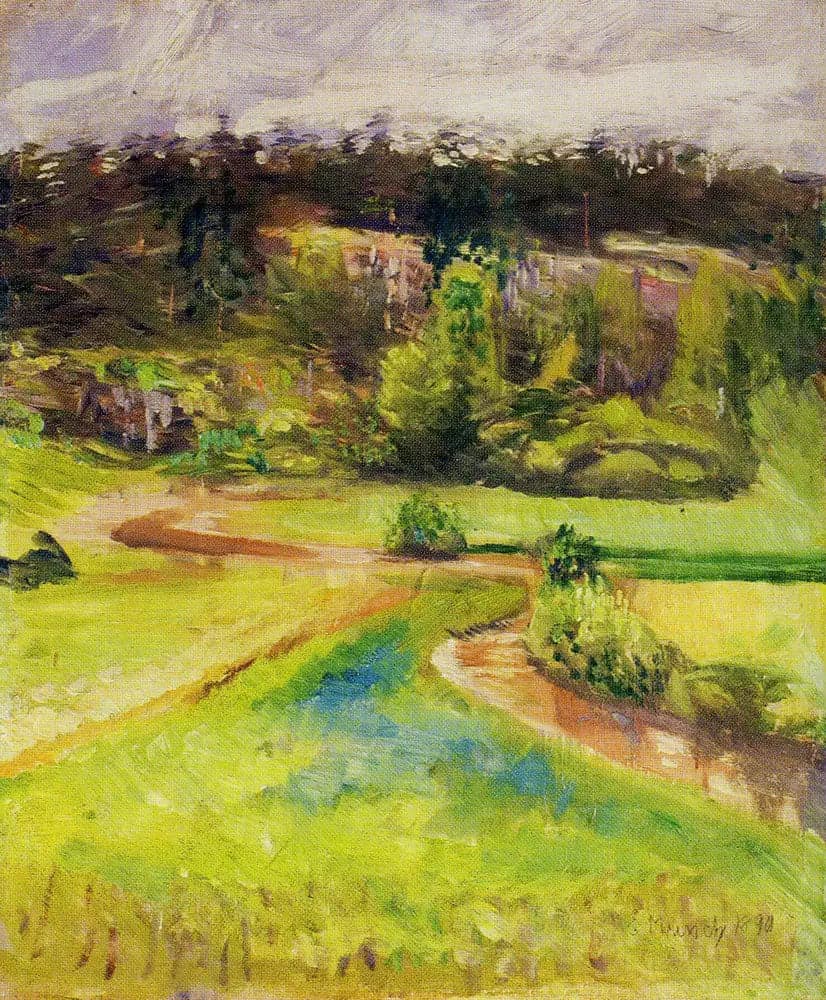
Landscape
- Original dimensions
- 31.9 x 35 cm
- Museum
- Bergen Art Museum
- Year
- 1890
Scene depicted
The painting “Landscape” reveals a vast view where imposing mountains, bathed in golden light, dominate a sky of delicate touch. The stylized shapes of the hills and the play of light create an atmosphere of meditation, an alternative space between dream and reality, like an invitation to connect with nature, all-powerful and majestic.
Historical context
Created in 1890, during the artistic effervescence of the late 19th century in Bergen, this painting is a poignant illustration of the expressionist movement, then emerging. Munch, a master of emotional representation, offers a unique perspective on nature here, capturing the raw beauty of a landscape through his prism marked by the tumult of the human soul. Currently, this canvas is preserved at the Bergen Art Museum, a setting that safeguards this pictorial work of infinite delicacy, measuring 31.9 x 35 cm.
Place in the artist's career
From carefree to mature, “Landscape” illustrates a pivotal intermediate phase of Munch, a turning point in his artistic journey where he experiments with the juxtaposition of forms and colors. Compared to his iconic works such as “The Scream” and “The Madonna,” this painting reveals a more serene facet of the artist, while foreshadowing the exploration of the human psyche that he cherishes so much.
Anecdote
“Nature is a mirror of our soul,” Munch said in a moment of reflection on his art. One spring morning, while walking in the heights of the Norwegian fjords, he was struck by the tranquility of the surrounding landscape. This painting embodies that feeling of fragile harmony, between sky and earth, solitude and serenity, thus relating to the pure emotion that inhabits Landscape .