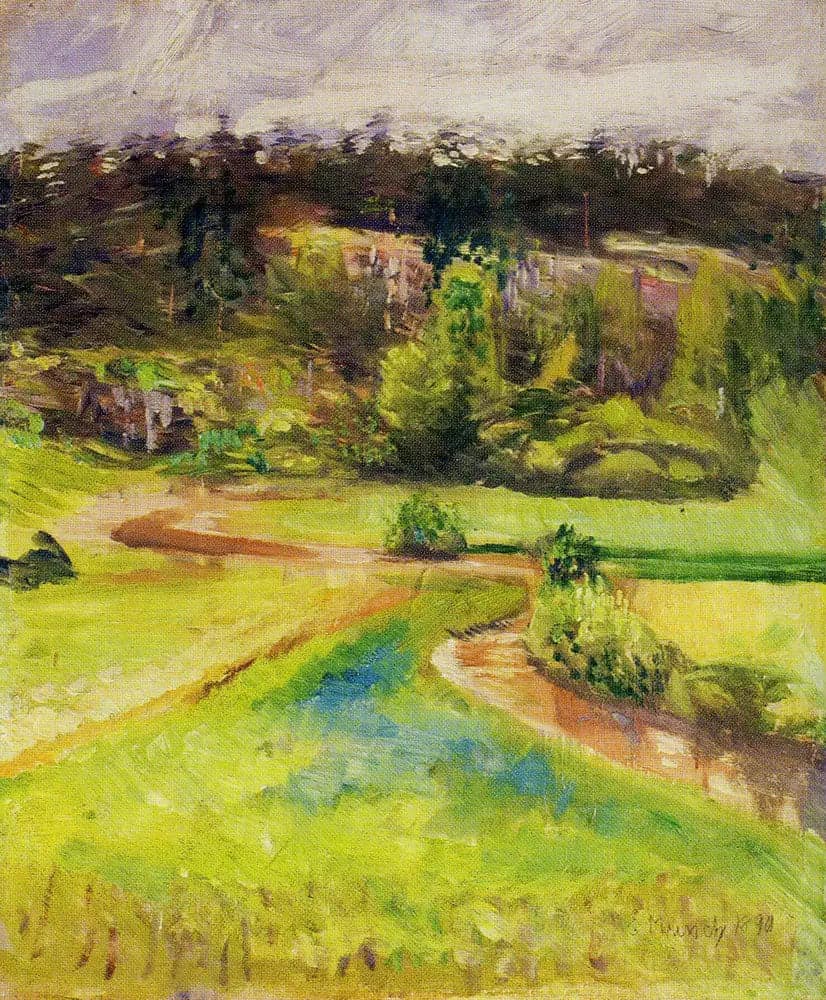
Landscape
- Original dimensions
- 39.5 x 47.5 cm
- Museum
- Not specified
- Year
- 1890
Scene depicted
In the painting “Landscape,” Munch offers us an impressionist view of a serene corner, where the hills blend into a sky filled with emotions. The composition evokes tranquility and introspection, inviting us to dive into the introspective universe of the artist. Each brushstroke seems to breathe the solitude and beauty perceived in nature.
Historical context
Created in 1890, at a time when Edvard Munch was revolutionizing expressionism , this painting captures the ephemeral beauty of a Scandinavian landscape. Munch, born in Norway, draws inspiration from the unique light of his homeland, which one could almost feel vibrating through the canvas . The painting is a celebration of the wild nature, a visual dialogue between the artist and his immediate environment.
Place in the artist's career
“Landscape” stands at the heart of Munch's artistic maturation, between his early attempts and more famous works like “The Scream” and “The Madonna.” It is a key step, where his style begins to flourish through more varied emotions and deep pictorial representations.
Anecdote
“I paint my dreams,” said Munch, evoking the lightning inspiration that led him to compose this masterpiece . Imagine him in the early morning, wandering through the Norwegian forests, cradled by the song of birds and enveloped by the scent of pines, describing the contours of a mental landscape on his canvas with passion.