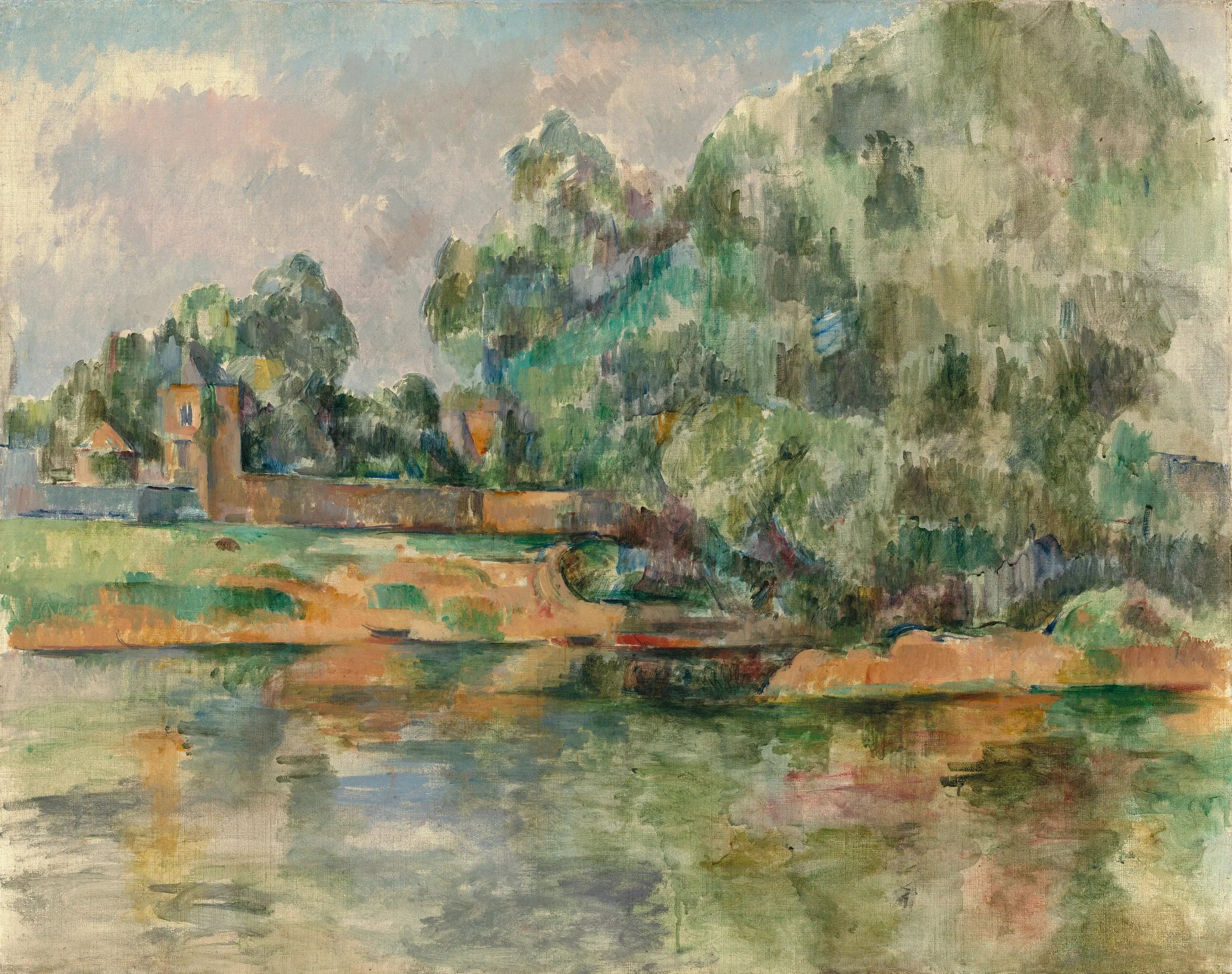
Landscape by the Water
- Original dimensions
- 92.3 x 73 cm
- Museum
- National Gallery of Art
- Year
- 1895
Scene depicted
In this pictorial work, the tranquility of the lagoon intertwines with the lush vegetation, while the water merges with the sky. The shapes are simplified yet vibrant, resulting from a careful gaze at nature. Each element of this scene is imbued with Cézanne's quest to capture the very essence of his natural environment, revealing a profound testimony of his love for the world around him.
Historical context
Created in 1895, this painting is a reflection of an innovative artistic movement, post-impressionism . Located in Washington D.C. at the National Gallery of Art , this canvas depicts the landscapes of the Aix-en-Provence region, an unknown cradle of Cézanne's productions. The work is set in a context where Cézanne sought to articulate light and form, making him a pioneer of modernity.
Place in the artist's career
This painting is situated at a pivotal moment in Cézanne's career, representing a period of artistic maturation. Alongside works such as “The Montagne Sainte-Victoire” and “The Card Players,” Cézanne reinforces his distinctive style, inevitably forging his legacy within modern art. The deep reflection on light and space in these works shows the progression of his technique leading towards subtle abstraction.
Anecdote
“I aspire to put light into every canvas I touch.” These words, filled with passion, resonate with the composition of this masterpiece . Imagine Cézanne standing by the water, awed by the dancing reflections at sunrise, inspiring each brushstroke with the energy of a spring morning.