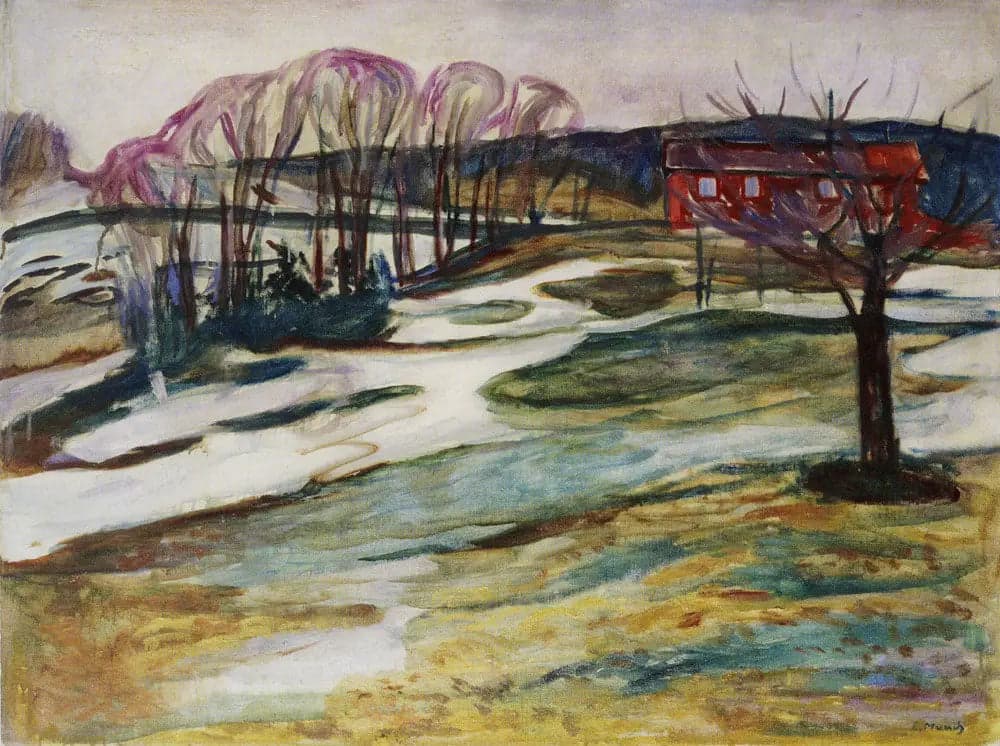
Landscape at the Red House
- Original dimensions
- 65.5 x 80 cm
- Museum
- Not specified
- Year
- 1902
Scene depicted
In this canvas, Munch captures the harmony between human architecture and the natural landscape. The red house, surrounded by vibrant greenery and a bright sky, awakens in us a sense of calm. This scene, although simple, is an invitation to contemplation and meditation, reflecting Norwegian tranquility.
Historical context
Created in 1902, Landscape at the Red House fits into the artistic context of the early 20th century, at a time when Edvard Munch , deeply influenced by symbolism , begins to express intense emotions through his canvases. This pictorial work represents a moment of tranquility, imbued with Scandinavian serenity, stemming from his years spent in Norway. Currently, the painting is not listed in a specific museum, but remains an essential piece of the legacy of this great artist.
Place in the artist's career
Landscape at the Red House represents an important milestone in Munch's career, illustrating his quest for beauty in the everyday. In parallel, works such as The Scream and The Dance of Life show the evolution of his style, where raw emotion is the common thread. This painting testifies to his ability to merge elements of nature with profound personal introspection.
Anecdote
“Nature speaks to me in its own language and I listen, attentive to the whispers of the wind.” This quote, inspired by Munch's passion for his native landscapes, perfectly illustrates the inspiration behind the masterpiece that is Landscape at the Red House . Imagine a peaceful morning, where the soft light of spring illuminates the red house, revealing all the magnificence of the surrounding nature.