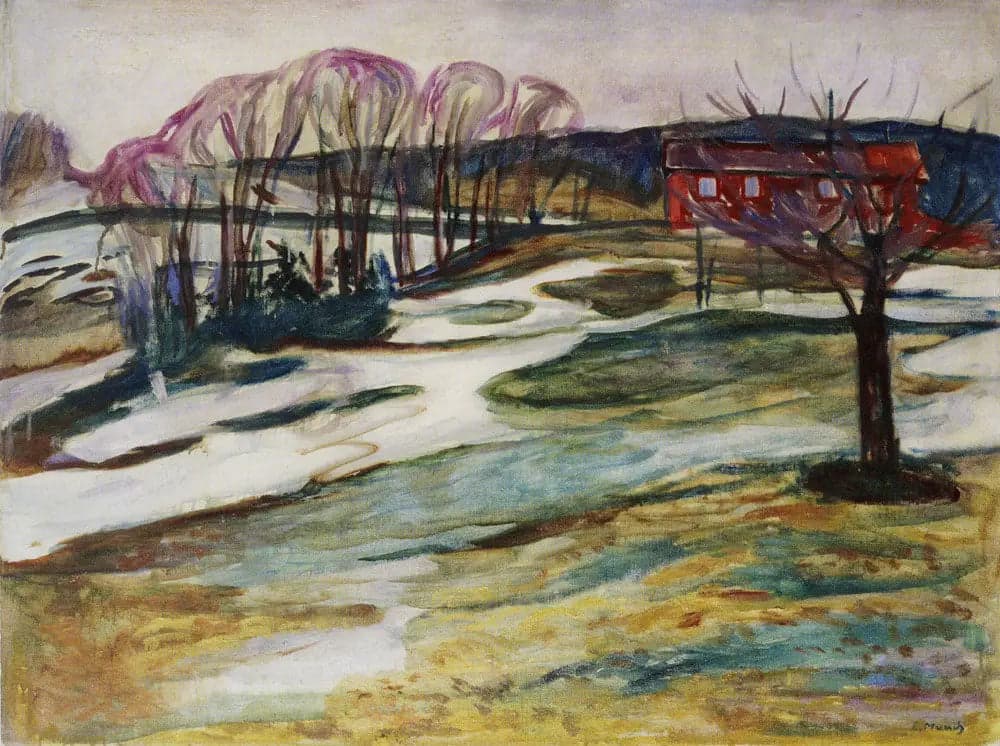
Landscape at the Red House
- Original dimensions
- 90 x 67 cm
- Museum
- Not specified
- Year
- 1925
Scene depicted
In this lovely pictorial work , Munch takes the viewer to the heart of a landscape frozen in time. The red house, a symbol of warmth and serenity, is framed by swaying trees and a cloudy sky, where vibrant colors evoke emotional depth. The painting conveys a contemplative atmosphere, an invitation to daydream within nature.
Historical context
Created in 1925, the iconic painting Landscape at the Red House immerses us in the unique universe of Edvard Munch , a pillar of symbolism and expressionism . This flagship canvas of modern art reveals complex emotions immersed in a transcended natural setting. Although the current location of the painting is not specified, it is deeply rooted in the global artistic heritage. The dimensions of the composition make it an impressive visual presence, ideal for enriching any interior space.
Place in the artist's career
Landscape at the Red House is part of the more mature phases of Edvard Munch's career. After his promising debut with works like The Scream, this painting represents a stylistic peak, where the artist merges technique and emotion. In parallel, one can mention other paintings such as The Madonna and The Dance of Life, marking a notable evolution in his exploration of themes of life and mortality.
Anecdote
"Nature has always fascinated me; it is never more than the shadow of my thoughts." This quote resonates deeply when considering the genesis of this masterpiece . Imagine Munch, on a gentle spring morning, wandering near a peaceful red house, capturing the essence of a tranquil scene and revealing the soul of his environment in his painting .