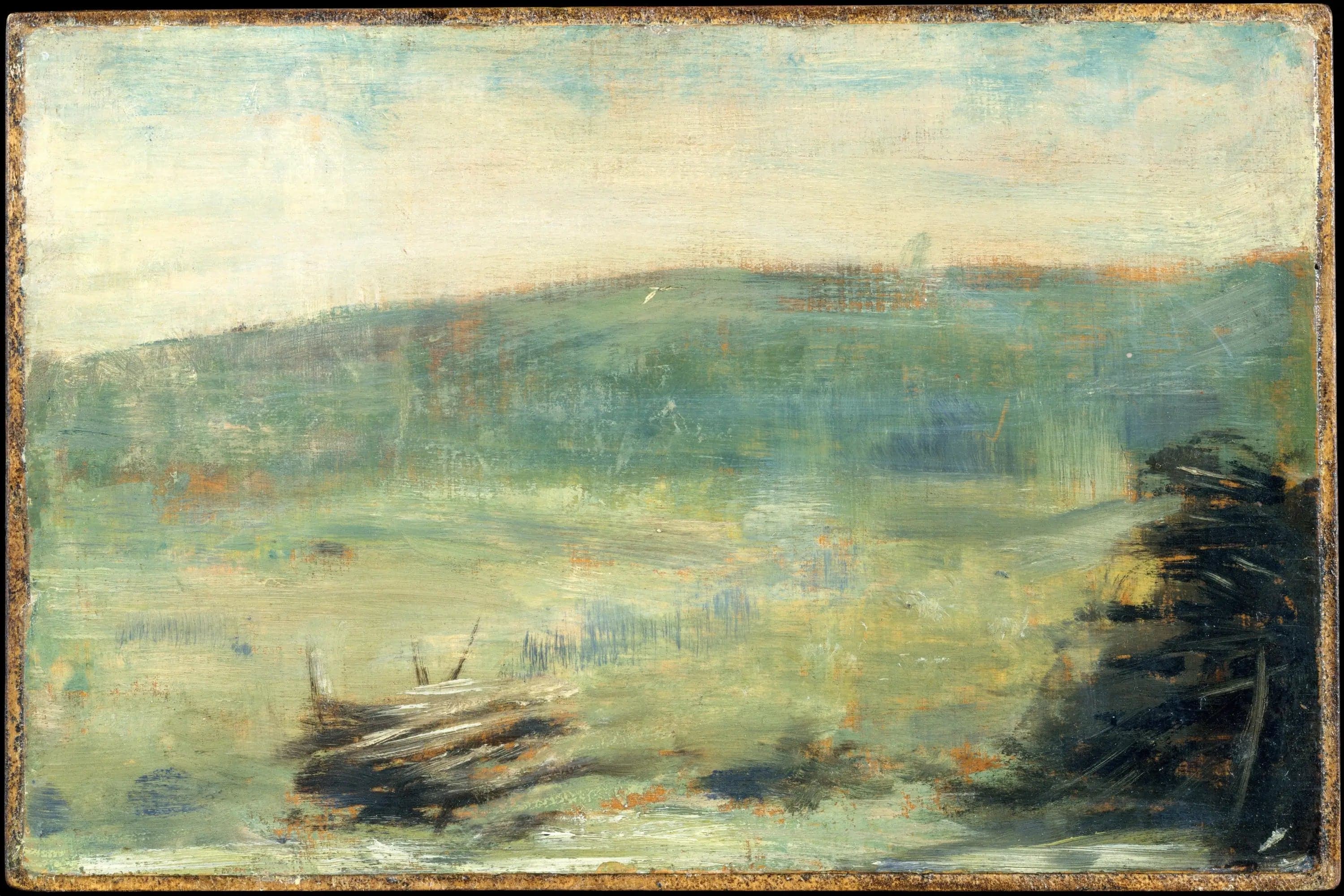
Landscape at Saint-Ouen
- Original dimensions
- 25.4 x 16.8 cm
- Museum
- Metropolitan Museum of Art
- Year
- 1878
Scene depicted
In this canvas, Seurat captures the tranquility of a suspended moment. The painting presents a peaceful landscape, where light dances on the green grass, blending with soothing colors. The human figures, representations of daily life, are subtle, almost evanescent, allowing the gaze to embrace the vast scene of nature, sometimes serene, sometimes vibrant.
Historical context
Created in 1878, in Saint-Ouen, an iconic city of the French landscape, this masterpiece belongs to the neo- impressionist movement. At that time, Seurat was developing innovative techniques that would mark the history of art. Today, the painting is housed in the prestigious setting of the Metropolitan Museum of Art , an art sanctuary located in New York, where it can be admired by thousands of visitors.
Place in the artist's career
Landscape at Saint-Ouen marks a significant milestone in Seurat's career, a precursor of pointillism. This work draws inspiration from his early explorations while heralding the artistic maturity that would come with La Grande Jatte and Les Poseuses. Through this composition, the evolution of his pictorial technique becomes evident, promising a redefinition of landscape.
Anecdote
Seurat once stated: “Painting is a poem that is seen rather than read.” This sentiment resonates deeply in the canvas of Landscape at Saint-Ouen, where each brushstroke evokes an enchanting morning. As he observed the moving landscape, the gentle whispers of the leaves and the scent of spring nourished his creativity. This pictorial work evokes emotion, transcended by the memory of ephemeral moments.